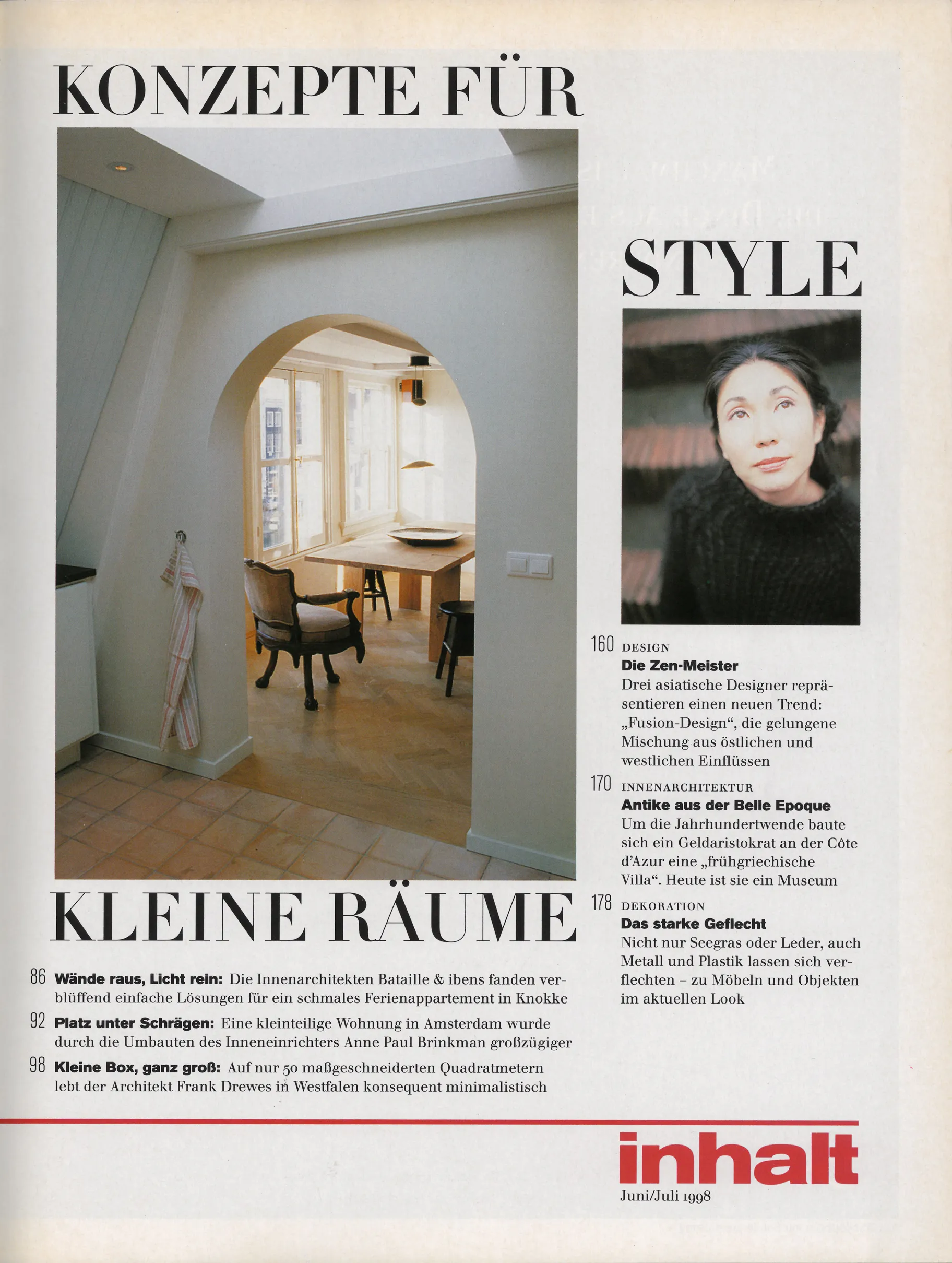
Architekture & Wohnen
The Zen Master (Die Zen-Meister)
June/July 1998
Three Asian designers represent a new trend: "fusion design," the blend of eastern and western influences.
It appears as if the Western world has caught a powerful Asia fever. In just the first half of the year, the Metropolitan Museum of Art’s new Chinese galleries have attracted nearly 300,000 curious visitors. The Guggenheim Museum’s show, China: 5000 Years, is so wide-ranging that it is being shown across two separate locations. At Paris’s Musée des Arts Décoratifs, Cloisonnés Chinois shines, and in a widely anticipated traveling exhibition, the work of Japanese designer Shiro Kuramata will be displayed. But that is just the tip of the iceberg.
Beyond culture, the passion for everything from the Far East has now begun to conquer commerce. Even in New York’s finest shops Asian wares are being offered—at corresponding prices. An especially large sensation was caused by Shanghai Tang. The newest branch of the Hong Kong fashion emporium founded by David Tang opened on Madison Avenue in New York’s most elegant shopping district. With over 3,300 square meters (35,000 square feet) of technicolor-esque flooring, it has everything from sterling silver chopsticks to flannel Mao jackets. The New York Times titled their article announcing the opening of this temple of merchandise, “The Great Mall of China.”
Interest in Eastern religions, especially Zen Buddhism, has never been greater. The mystic art of feng shui (an ancient Chinese philosophy concerned with the balancing of spatial energies) has become part of the mantra of the Western designer. Already, feng shui masters are routinely consulted on the construction of million-dollar apartments in California and Manhattan. And nearly every month a new ‘how-to’ book appears addressing this theme.
Asiaphilia is not a new phenomenon. Chinoiserie was in fashion in European aristocratic courts of the 17th and 18th centuries; and in the 19th century, artists were influenced by work from and about Japan. What is new is the way in which Eastern and Western perspectives come together. Similar to how so-called ‘fusion cuisine’ has found its way to the best cooking of the western world—the application of oriental coriander to Italian pesto comes to mind—fashion and interior design have brought about their own ‘fusion design.’ An unsurprising development, considering that the balance between the two opposing poles of Yin and Yang lies at the heart of Chinese philosophy.
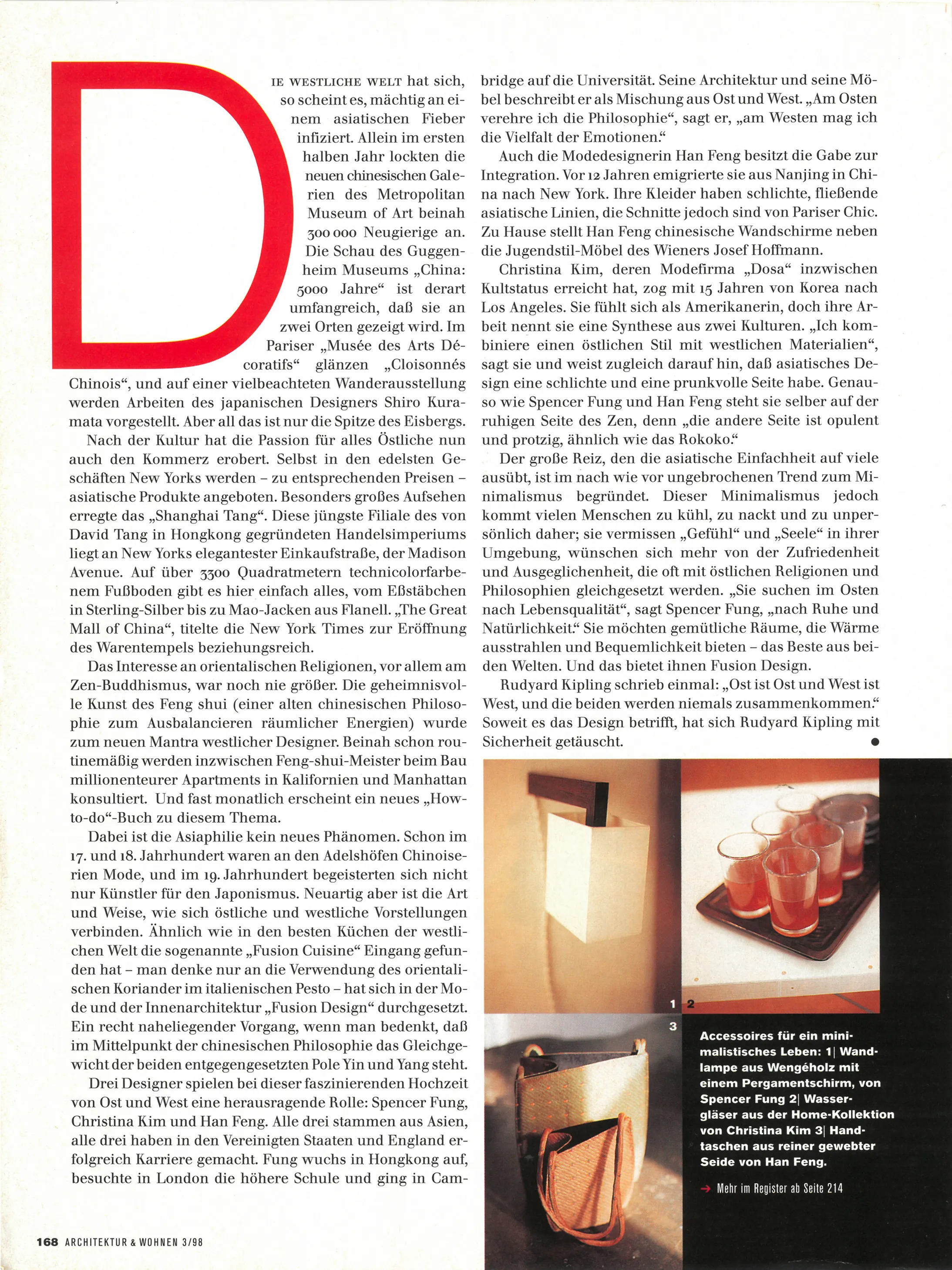
Three designers play particularly exceptional roles in this fascinating marriage of East and West: Spencer Fung, Christina Kim, and Han Feng. All three were born in Asia and all three have established successful careers in the United States and England. Fung grew up in Hong Kong, attended part of his higher schooling in London before going to Cambridge University. He describes his architecture and his furniture as a mixture of East and West. “I revere the philosophy of the East,“ he says, “I like the diversity of emotions of the West.”
The fashion designer Han Feng also possesses the gift of integration. She emigrated from Nanjing, China to New York twelve years ago. Her clothing pieces have simple, flowing Asian lines, and the shapes are all-the-while Paris chic. At home, Han Feng places Chinese wall screens next to Jugendstil furniture from the Viennese designer Josef Hoffmann.
Christina Kim, whose fashion line dosa has achieved a kind of cult status, moved at 15 from Korea to Los Angeles. She feels American, but her work calls her out as a synthesis of two cultures. “I combine Eastern style with Western materials,” she said and pointed out that Asian design has simple and more opulent sides. Just like Spencer Fung and Han Feng, she is on the quieter side of Zen, because, “the other side is opulent, similar to Rococo.”
The main appeal that Asian simplicity works on many of us is grounded, today as well as earlier, in an unbroken trend from minimalism. But this minimalism strikes many people as too cold, too naked and too impersonal; they miss “feeling” and “soul” in their surroundings, and wish for more contentment and balance, ideas often associated with Eastern religions and philosophies. “In the East, they look for quality of life,” said Spencer Fung, “for quiet and naturalness.” They want hospitable rooms that radiate warmth and offer comfort—the best of both worlds. And Fusion Design offers them that.
Rudyard Kipling once wrote: “East is East and West is West and never the twain shall meet.” As far as design is concerned, Rudyard Kipling was surely mistaken.
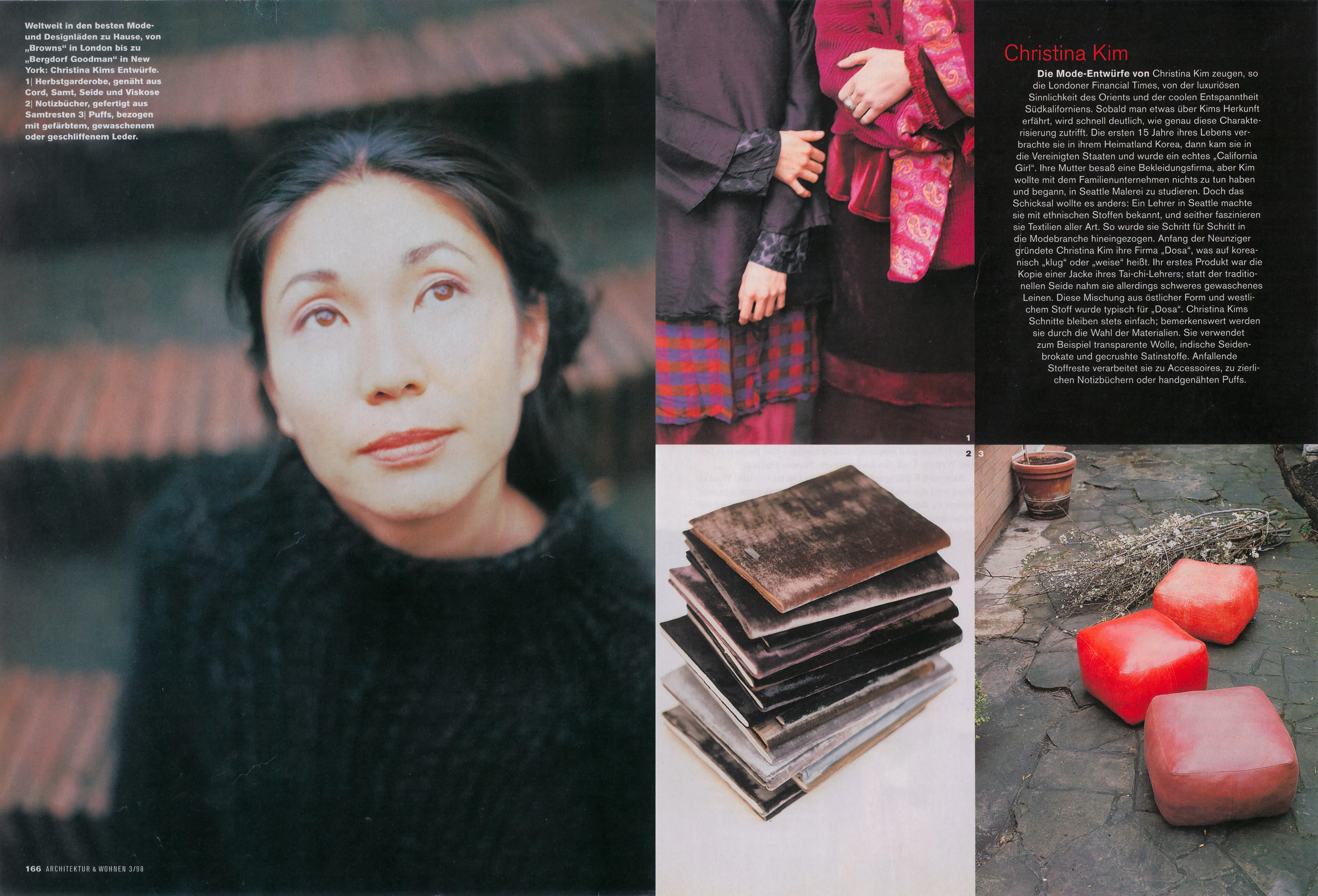
**Christina Kim
**The fashion designs of Christina Kim testify, according to the London Financial Times, to the luxurious sensuality of the East, and the cool relaxation of Southern California. As soon as one learns something of Kim’s origins, it becomes clear how accurate this characterization is. She lived the first 15 years of her life in her family’s homeland, Korea, then came to the United States and became a true “California girl.” Her mother had a clothing company, but Kim didn't want anything to do with the family business, and moved to Seattle to study painting. But fate would have it otherwise: her professor [Jacob Lawrence] acquainted her with ethnic fabrics and since then she has had a fascination with all kinds of textiles. And so, step by step, she was pulled into the fashion industry. At the beginning of the 80’s, Christina Kim founded her company, dosa, which means smart or wise in Korean. One of her first pieces was a copy of her tai chi teacher’s jacket; but instead of traditional silk she used heavy washed linen. This mix of Eastern shape and Western fabric would become typical for dosa. Christina Kim’s forms remain simple; her choice of materials is especially of note. She uses, for example, sheer wool, Indian silk brocades, and crushed satin fabrics. She reworks leftover fabric cutoffs into accessories, delicate notebooks, and hand-sewn poufs.
text: Arlene Hirst
photo: Don Freeman
production: Thomas Niederste-Werbeck
stylist: Kathy Park
english translation: Lindon Schultz