Design Your Lifestyle
The Life and Adventures of dosa: Turning Even A Scrap of Cloth into Art (한 조각 천까지 예술로 만들다: 도사dosa의 삶과 모험)
October 2019
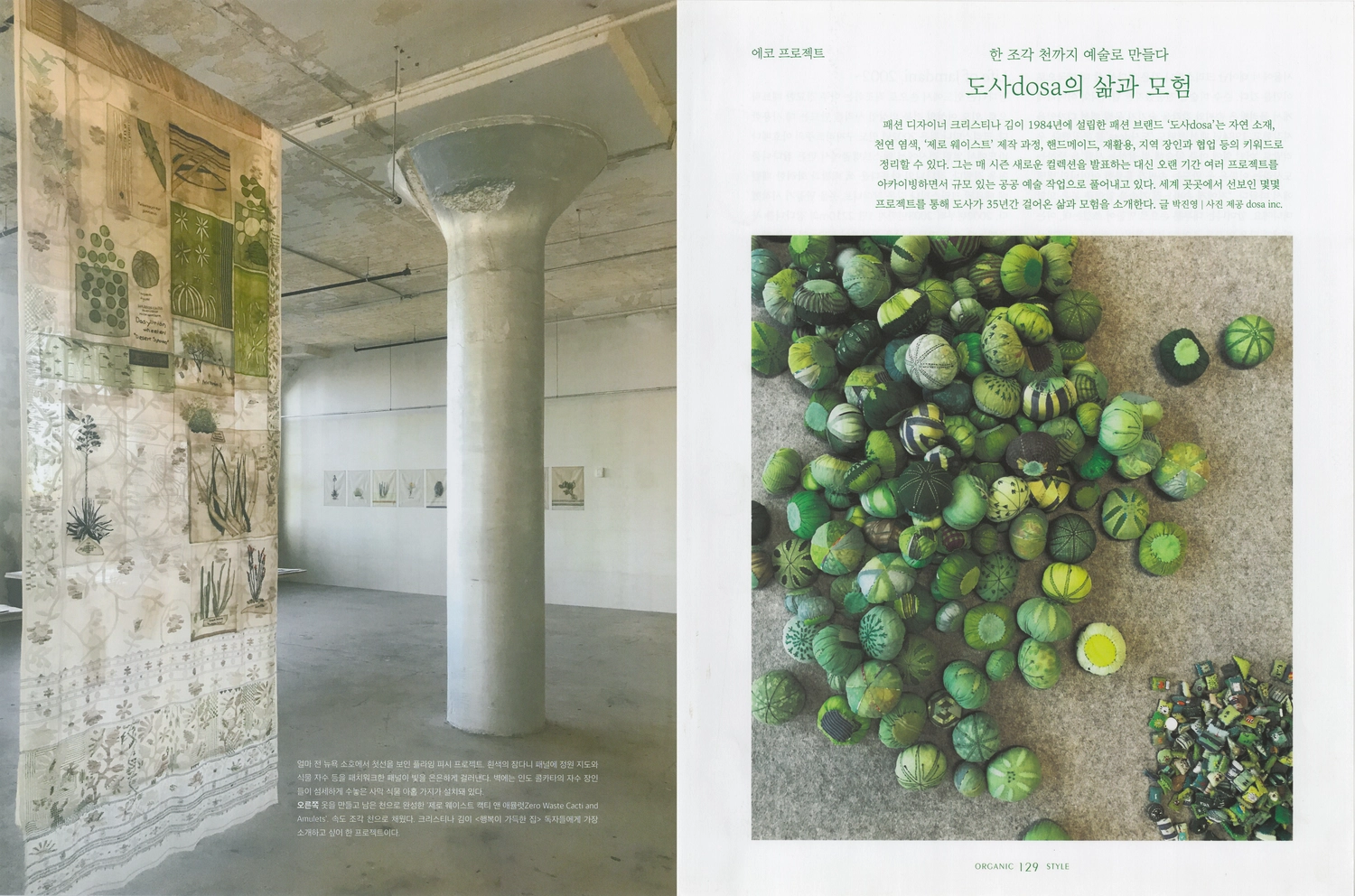
Founded in 1984 by [...] designer Christina Kim, [...] dosa can be described through keywords such as natural materials, natural dyeing, zero-waste production process, handwork, recycling, and collaborations with local artisans. Instead of presenting a new collection each season, Kim has spent many years archiving her various projects and transforming them into large-scale public art projects. Through several projects presented around the world, this article introduces the life and adventures of dosa over the past 35 years.
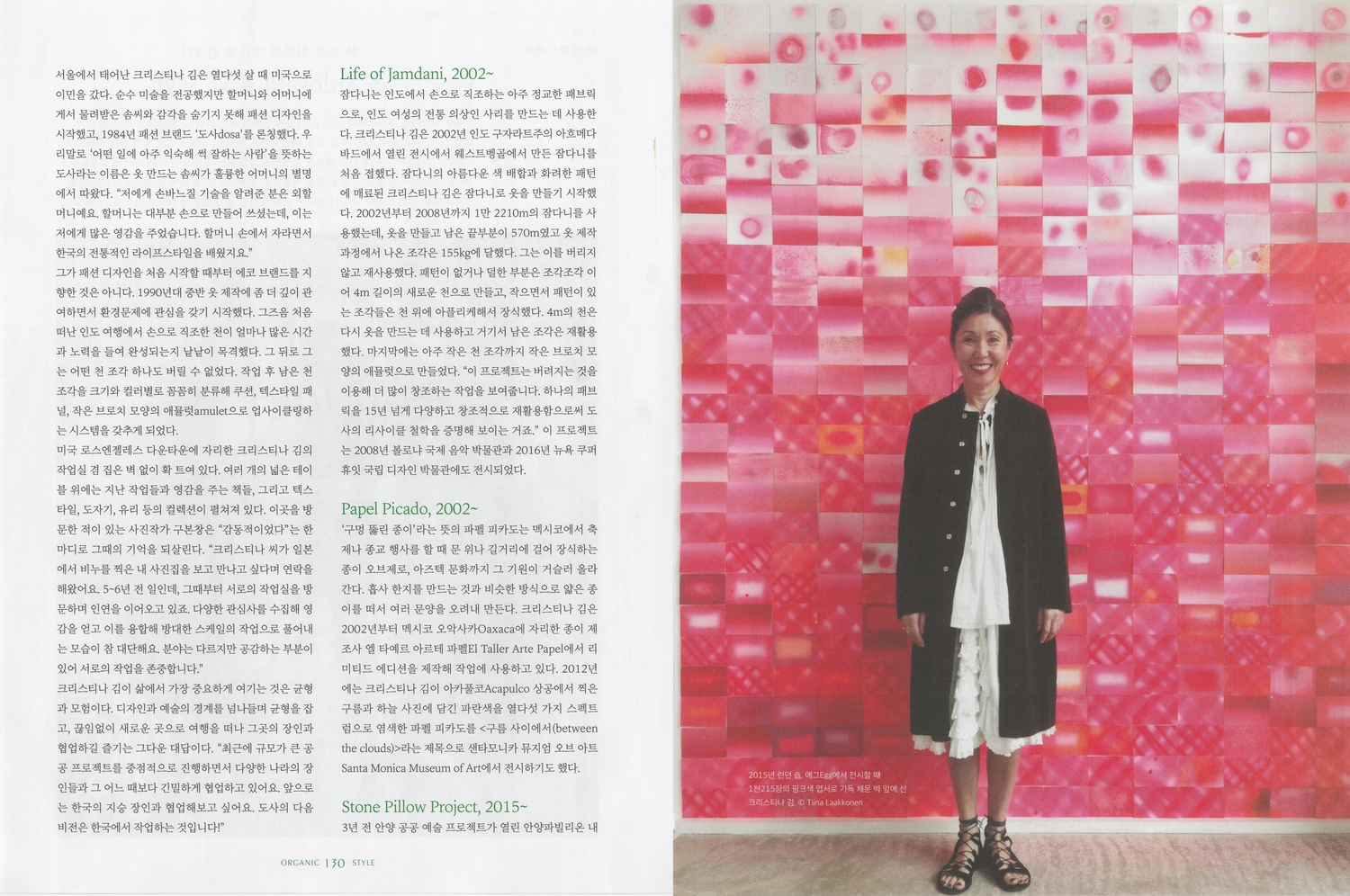
Born in Seoul, Christina Kim immigrated to the United States at the age of fifteen. Although she studied fine art, she could not hide the craftsmanship and sensibility she had inherited from her grandmother and mother, and eventually began designing fashion. In 1984, she launched [...] dosa. The name dosa, which in Korean means a person who is extremely skilled at something, was taken from her mother’s nickname, given to her because of her exceptional talent for making clothes.
“My maternal grandmother was the one who taught me hand-sewing techniques. She made most things by hand, and that became a great source of inspiration for me. Growing up under my grandmother’s care, I learned a traditional Korean way of life.”
Kim did not set out to create an eco-conscious brand from the very beginning. In the mid-1990s, as she became more deeply involved in clothing production, she began to take an interest in environmental issues. Around that time, on her first trip to India, she witnessed in detail just how much time and labor went into completing a handwoven piece of cloth. Since then, she has been unable to throw away even a single scrap of fabric. She developed a system of meticulously sorting leftover fabric pieces by size and color, then upcycling them into cushions, textile panels, and small brooch-like amulets.
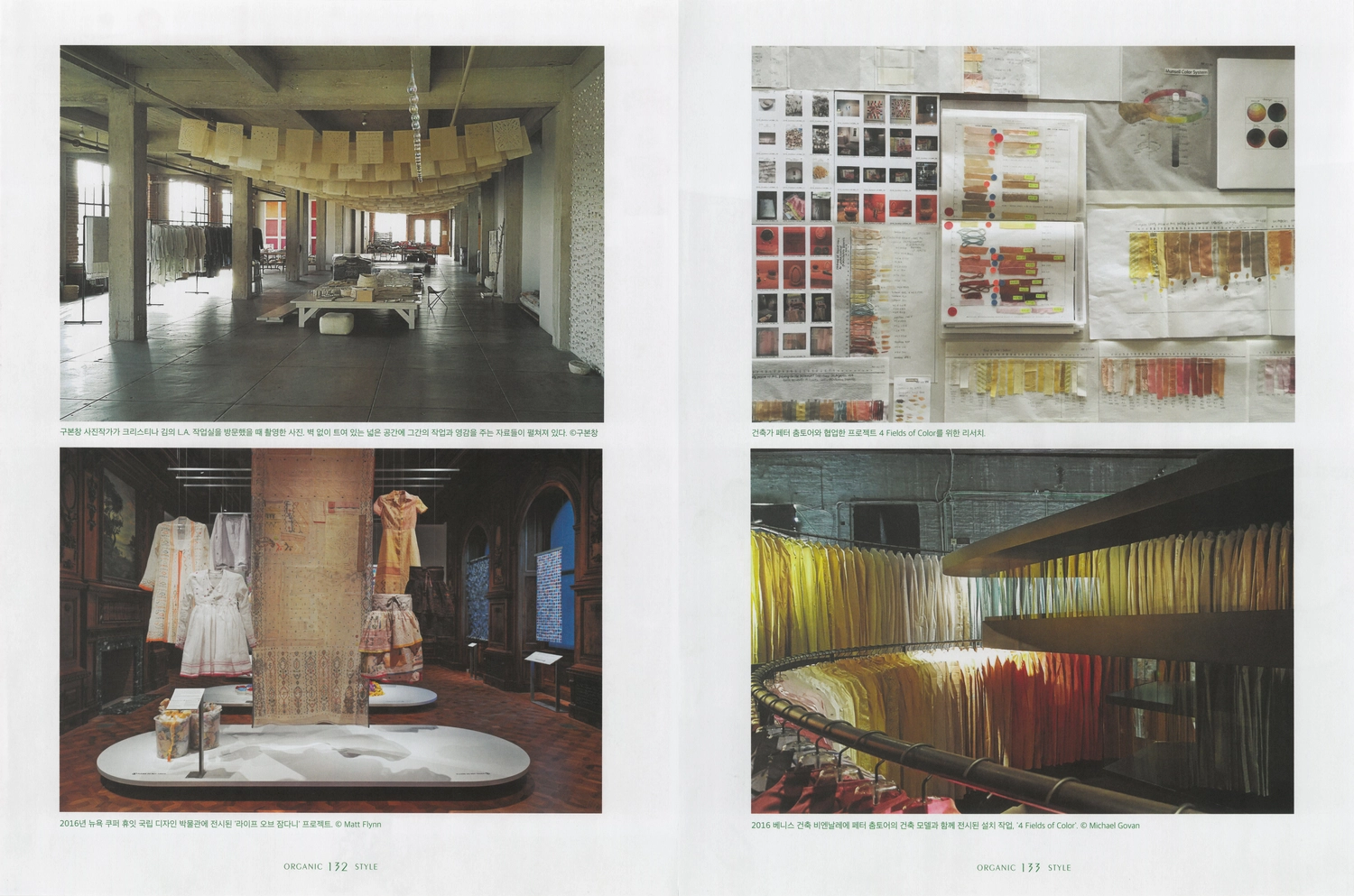
Christina Kim’s studio and home in downtown Los Angeles is an open space without walls. Across several large tables are past works, books that inspire her, and collections of textiles, ceramics, and glass objects. Photographer Bohnchang Koo, who has visited the space, recalls the experience in one word: “moving.”
“Christina contacted me after seeing my photo book of soaps photographed in Japan, saying she wanted to meet me. That was five or six years ago, and since then we have continued our connection by visiting each other’s studios. It is remarkable to see how she collects various interests, draws inspiration from them, fuses them together, and develops them into works of such vast scale. Although we work in different fields, there are things we relate to in each other’s work, and we respect one another’s practice.”
The things Christina Kim values most in life are balance and adventure, which sounds very true to her: someone who moves between design and art while maintaining balance, and who constantly enjoys traveling to new places and collaborating with artisans there.
“Recently, as I have been focusing on large-scale public projects, I have been collaborating more closely than ever with artisans from many different countries. In the future, I would like to work with Korean jiseung artisans. The next vision for dosa is to work in Korea!”
Life of Jamdani, 2002–
Jamdani is an extremely delicate handwoven fabric from India used to make saris, the traditional garment worn by Indian women. In 2002, Christina Kim first encountered West Bengal-made jamdani at an exhibition held in Ahmedabad, Gujarat, India. Captivated by jamdani’s beautiful color combinations and elaborate patterns, she began making clothes with the fabric.
From 2002 to 2008, she used 12,210 meters of jamdani. The end pieces left over after making clothing amounted to 570 meters, while the scraps generated during the production process weighed 155 kilograms. Instead of discarding them, Kim reused them. Sections with little or no pattern were pieced together to create new four-meter lengths of fabric, while small patterned fragments were appliquéd onto cloth as decoration. The four-meter cloths were then used again to make clothing, and the scraps left from those garments were recycled once more. Finally, even the tiniest pieces of fabric were turned into small brooch-like amulets.
“This project shows how one can create more by using what would otherwise be discarded. By recycling a single fabric in diverse and creative ways for more than fifteen years, it demonstrates dosa’s ’s philosophy of recycling.”
The project was exhibited at the International Museum and Library of Music in Bologna in 2008 and at the Cooper Hewitt, Smithsonian Design Museum in New York in 2016.
Papel Picado, 2002–
Papel picado, meaning perforated paper, is a paper object hung above doorways or across streets in Mexico for festivals and religious ceremonies. Its origins can be traced back to Aztec culture. Made in a way somewhat similar to Korean hanji, thin sheets of paper are formed and cut into various patterns.
Since 2002, Christina Kim has been producing limited editions at El Taller Arte Papel, a paper-making workshop in Oaxaca, Mexico, and using them in her work. In 2012, she exhibited papel picado dyed in fifteen shades of blue, based on the blue tones found in photographs of clouds and sky that she had taken over Acapulco. The work, titled Between the Clouds, was shown at the Santa Monica Museum of Art.
Stone Pillow Project, 2015–
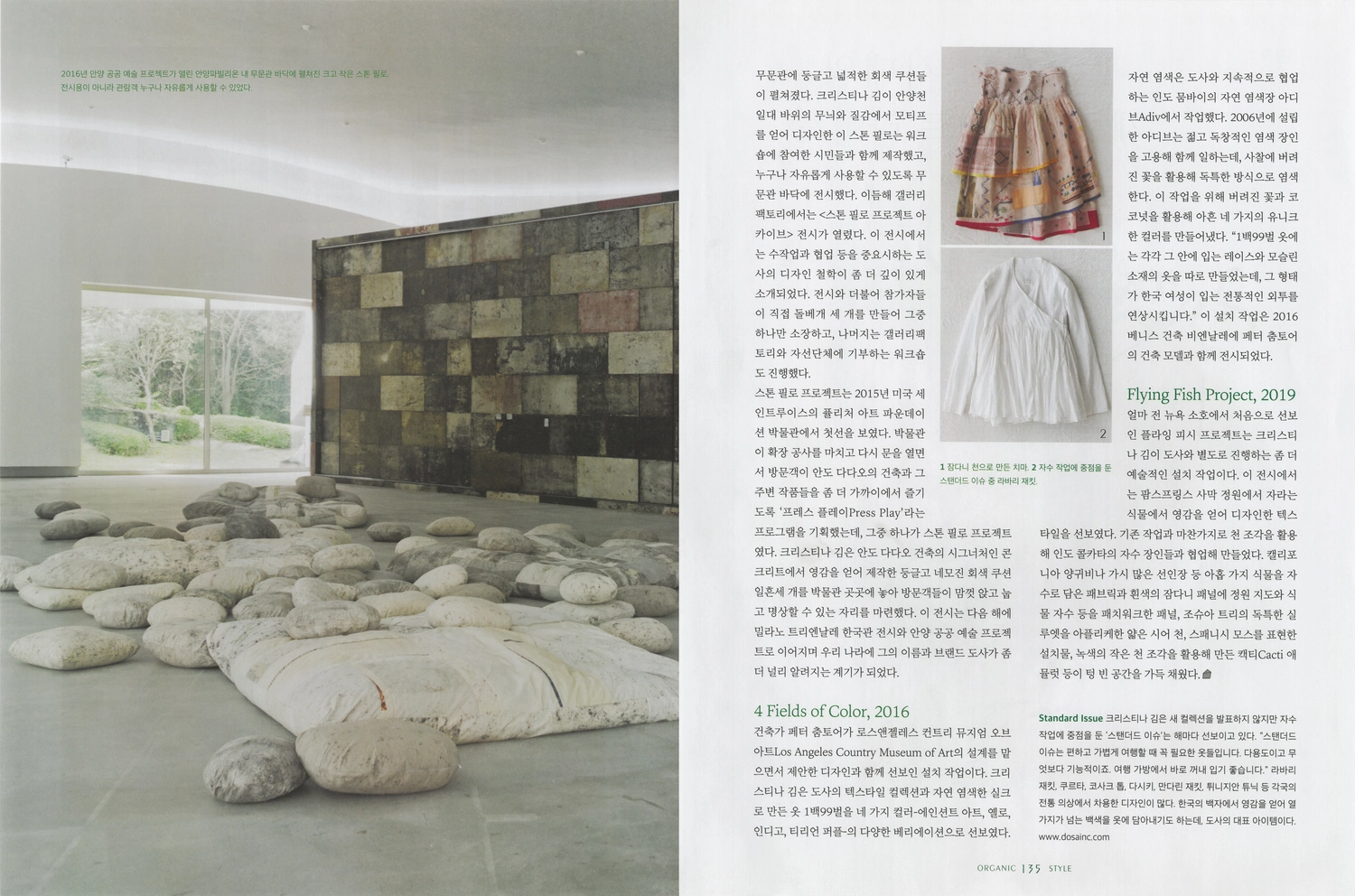
Three years ago, during the 5th Anyang Public Art Project, round, broad, flat gray cushions were spread across the Anyang Pavilion. These Stone Pillows, designed by Christina Kim and inspired by the patterns and textures of rocks around Anyangcheon Stream, were made together with citizens who participated in workshops. They were displayed on the floor of the pavilion so that anyone could freely use them.
The following year, Gallery Factory held the exhibition Stone Pillow Project Archive. The exhibition introduced dosa’s ’s design philosophy in greater depth, emphasizing handwork and collaboration. Alongside the exhibition, a workshop was held in which participants made three stone pillows themselves, kept one, and donated the remaining two to Gallery Factory and to a charitable organization.
The Stone Pillow Project was first presented in 2015 at the Pulitzer Arts Foundation in St. Louis, United States. When the museum reopened after its expansion, it organized a program called Press Play, designed to allow visitors to experience Tadao Ando’s architecture and the surrounding artworks more intimately. One part of that program was the Stone Pillow Project.
Inspired by concrete, the signature material of Tadao Ando’s architecture, Christina Kim created seventy-three round and square gray cushions and placed them throughout the museum, giving visitors places where they could freely sit, lie down, and meditate. The exhibition continued the following year at the Korean Pavilion of the Milan Triennale and at the Anyang Public Art Project, helping to make both Kim’s name and the brand dosa more widely known in Korea.
4 Fields of Color, 2016
This installation was presented together with the design proposed by architect Peter Zumthor for the Los Angeles County Museum of Art. Christina Kim presented 199 garments made from dosa’s textile collection and naturally dyed silk, in four fields of color: Ancient Art, Yellow, Indigo, and Tyrian Purple. The natural dyeing was carried out by Adiv, a natural dye workshop in Mumbai, India, with which dosa has maintained an ongoing collaboration. Founded in 2006, Adiv employs local dye artisans, and uses flowers discarded from temples to dye fabric in distinctive ways. For this project, they created ninety-four unique colors using discarded flowers and coconuts.
For each of the 199 garments, separate lace and muslin pieces were made to be worn underneath. Their forms evoke the traditional outer garments worn by Korean women. The installation was exhibited together with Peter Zumthor’s architectural models at the 2016 Venice Architecture Biennale.
flyingfishprojects, 2019
flyingfishprojects, presented for the first time recently in SoHo, New York, is a more artistic installation project that Christina Kim has pursued separately from dosa . The exhibition presented textiles designed with inspiration from plants growing in the desert gardens of Palm Springs.
As in her previous works, Kim used fabric scraps and collaborated with embroidery artisans in Kolkata, India. The empty space was filled with embroidered fabrics depicting nine plants, including California poppies and thorny cacti; panels in which garden maps and plant embroidery were patchworked onto white jamdani panels; sheer fabric appliquéd with the distinctive silhouette of Joshua trees; an installation representing Spanish moss; and cacti amulets made from small pieces of green fabric.
standard issue
Christina Kim does not present new collections, but she does introduce Standard Issue, a line centered on handwork, each year.
“standard issue consists of clothes that are essential for comfortable, lightweight travel. They are versatile, and above all, functional. They are easy to pull straight out of a suitcase and wear.”
Many of the designs are borrowed from traditional garments from different countries, including the Rabari jacket, kurta, Cossack top, dashiki, mandarin jacket, and Tunisian tunic. Kim has also expressed more than ten shades of white in garments inspired by Korean white porcelain. These have become some of dosa’s signature items.
text: Park Jin-young
photo: dosa inc.
english translation: Soo Jin Hwang