Elle Decoration
PROFILE DOSA: A modern Asian vision of fashion and home
June 1997
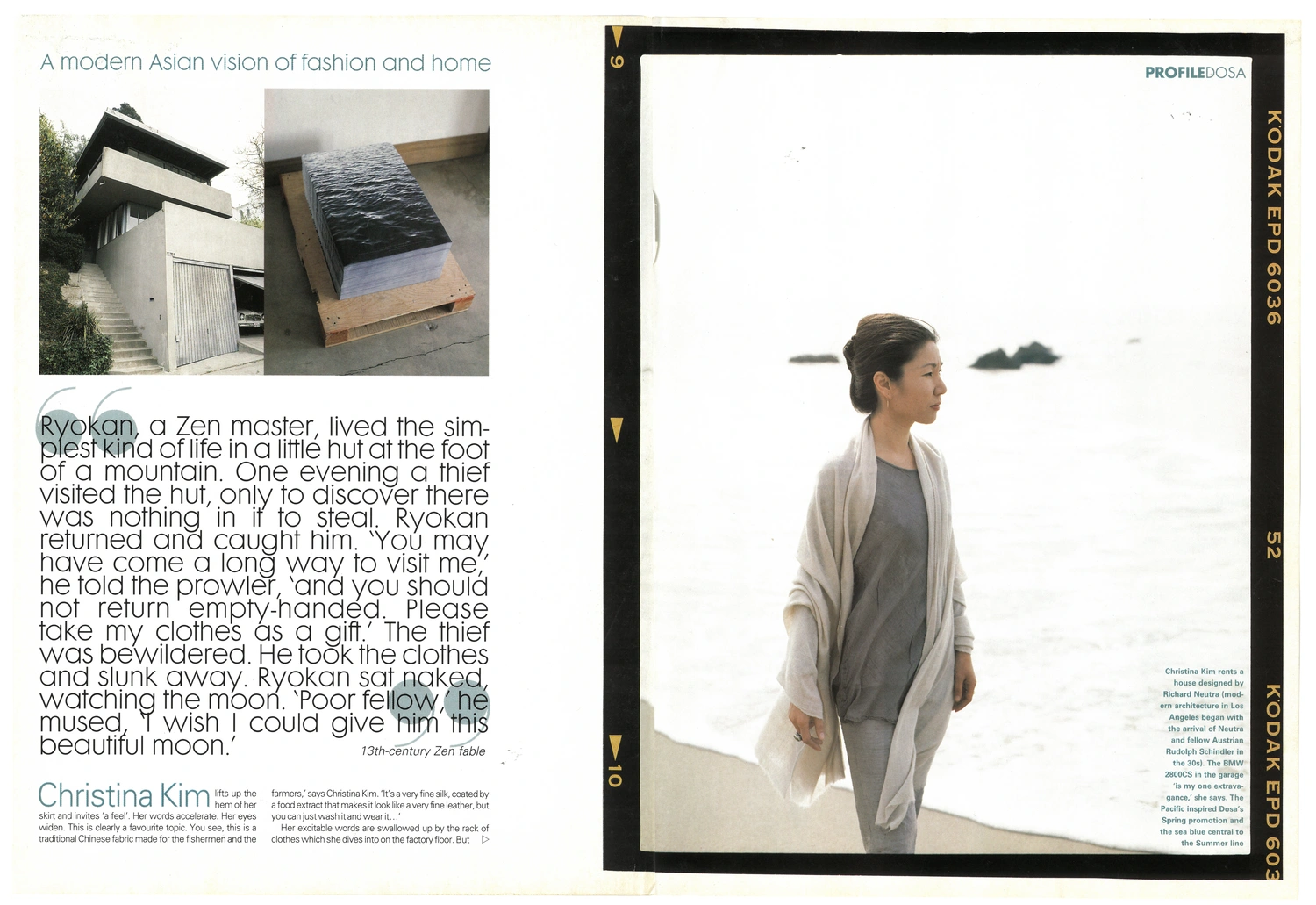
Ryokan, a Zen master, lived the simplest kind of life in a little hut at the foot of a mountain. One evening a thief visited the hut, only to discover there was nothing in it to steal. Ryokan returned and caught him. “You may have come a long way to visit me,” he told the prowler, “and you should not return empty-handed. Please take my clothes as a gift.” The thief was bewildered. He took the clothes and slunk away. Ryokan sat naked, watching the moon. “Poor fellow,” he mused, “I wish I could give him this beautiful moon.” —13th-century Zen fable
Christina Kim lifts up the hem of her skirt and invites a feel. Her words accelerate. Her eyes widen. This is clearly a favourite topic. You see, this is a traditional Chinese fabric made for the fishermen and the farmers, says Christina Kim. “It’s a very fine silk, coated by a food extract that makes it look like a very fine leather, but you can just wash it and wear it...”
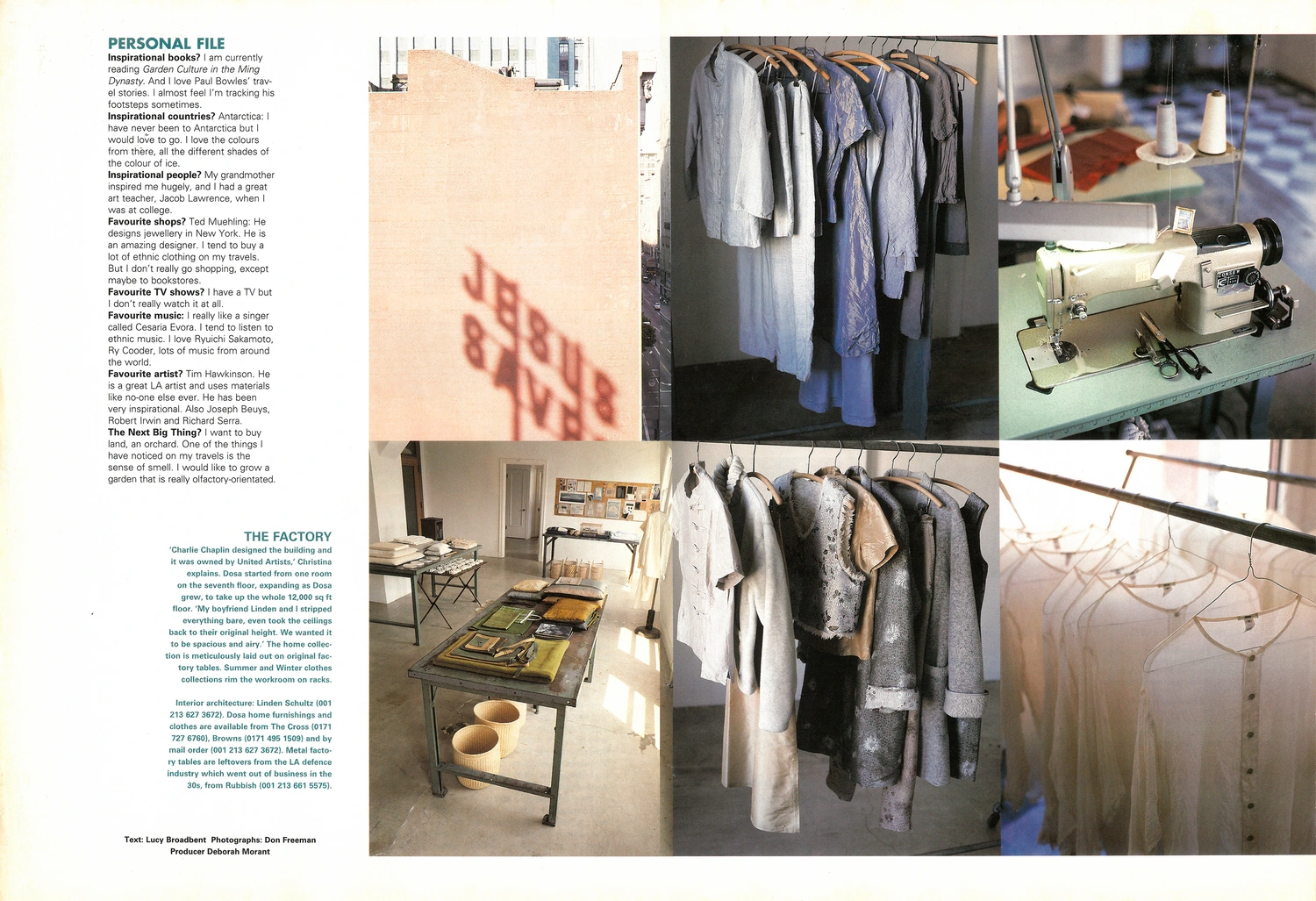
Her excitable words are swallowed up by the rack of clothes which she dives into on the factory floor. But re-emerging with another item from her line to show off, she continues with equal speed and velocity. “Now stroke this,” she says, referring to a Cambodian silk slip dress. “Isn’t that colour wonderful?”
This year the exuberant Korean-American has been recognised as one of the hottest new designers to emerge in the United States. Her company, Dosa, has become a style icon, known for its transfusion of Eastern and Western cultures, creating ultra-hip clothes and home furnishings now sold in exclusive shops like Browns and The Cross in the UK.
And the company’s success stems directly from Christina’s zeal for all things traditional from around the world, which she incorporates and modernises—not only in her products, but in her daily life as well as her own home. Every other month she travels to the Third World to investigate a new textile to embrace in her modern designs.
“Nicole Kidman was in Browns in London last month and she bought 11 of our outfits.”
And Miranda Richardson also bought a bunch of stuff, too,” says Christina, finally sitting down at a table in her stark, white, minimalist factory, refurbished in a run-down Art Deco high-rise in downtown Los Angeles. She is a petite woman, whose neither looks nor acts 40 years old, and who is slightly flabbergasted by her own success.
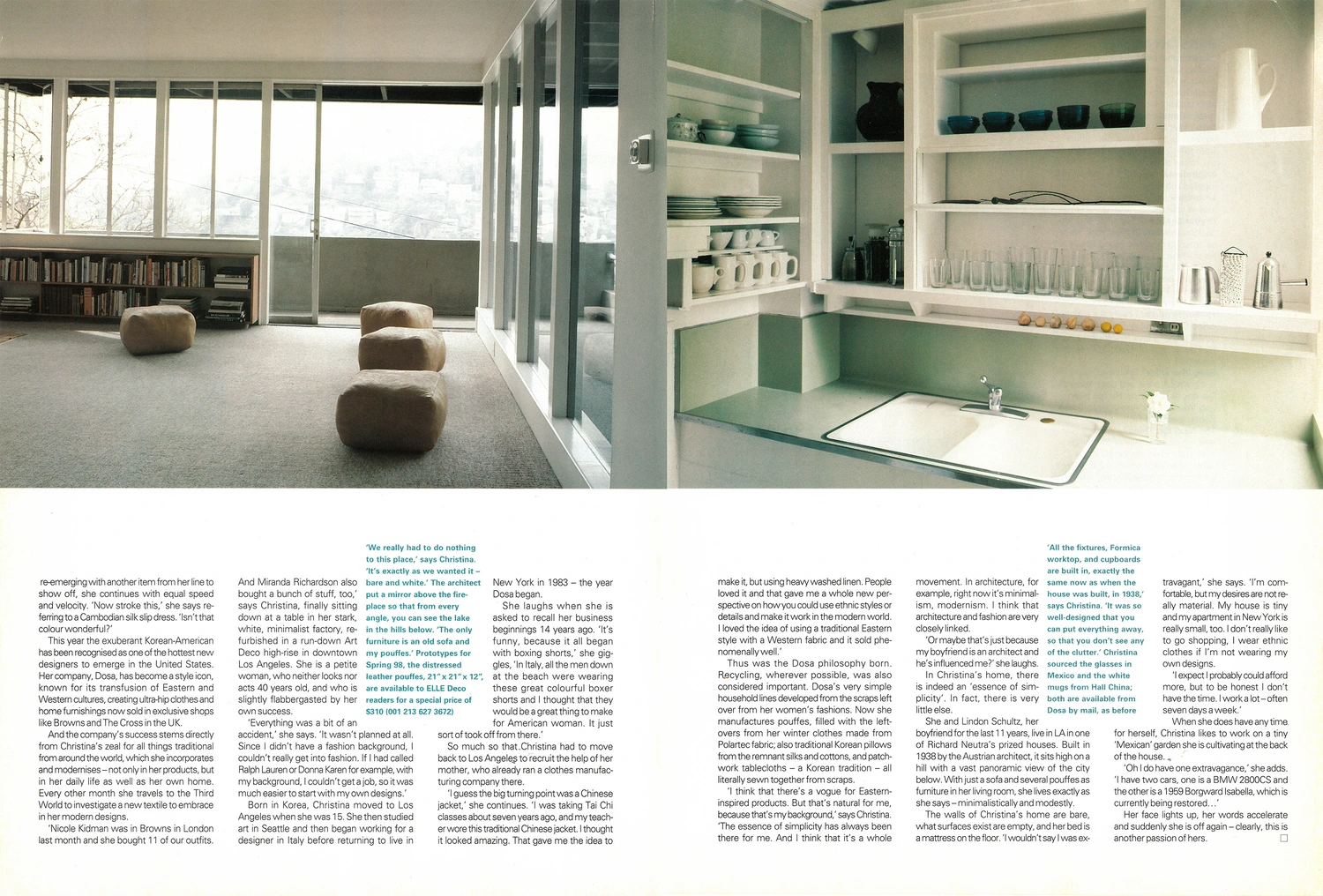
“We really had to do nothing to this place,” says Christina. “It’s exactly as we wanted it—bare and white.” The architect put a mirror above the fireplace so that from every angle, you can see the lake in the hills below. “The only furniture is an old sofa and my pouffes.” Prototypes for Spring 98, the distressed leather pouffes, 21" x 21" x 12", are available to ELLE Deco readers for a special price of $310 (001 213 627 3672).
“Everything is a bit of an accident,” she says. “It wasn’t planned at all. Since I didn’t have a fashion background, I couldn’t really get into fashion. If I had called Ralph Lauren or Donna Karan for example, with background, I couldn’t get a job, so it was more like to start with my own designs.”
Born in Korea, Christina moved to Los Angeles when she was 15. She then studied art in Seattle and then began working for a designer in Italy before returning to live in New York in 1983—the year Dosa began.
She laughs when she is asked to recall her business beginnings 14 years ago. “It’s funny, because it all began with boxing shorts,” she giggles. “In Italy, all the men down at the beach were wearing these great colourful boxer shorts and I thought that they would be a great thing to make for American women. It just sort of took off from there.”
So much so that Christina had to move back to Los Angeles to recruit the help of her mother, who already ran a clothes manufacturing company there.
“I guess the big turning point was a Chinese jacket,” she continues. “I was taking Tai Chi classes about seven years ago, and my teacher wore this traditional Chinese jacket. I thought it looked amazing. That gave me the idea to make it, but using heavy washed linen. People loved it and that gave me a whole new perspective on how you could use ethnic styles or details and make it work in the modern world. I loved the idea of using a traditional Eastern style with a Western fabric and it sold phenomenally well.”
Thus was the Dosa philosophy born. Recycling, wherever possible, was also considered important. Dosa’s very simple household lines developed from the scraps left over from her women’s fashions. Now she manufactures poufs, filled with the leftovers from her winter clothes made from Polartec fabric; also traditional Korean pillows from the remnants silks and cottons, and patchwork tablecloths—a Korean tradition—all literally sewn together from scraps.
“I think that there’s a vogue for Eastern-inspired products. But that’s natural for me, because that’s my background,” says Christina. “The essence of simplicity has always been there for me. And I think that it’s a whole movement. In architecture, for example, right now it’s minimalism, modernism. I think that architecture and fashion are very closely linked.”
Or maybe it’s just because my boyfriend is an architect and he’s influenced me?” she laughs.
In Christina’s home, there is indeed an “essence of simplicity”. In fact, there is very little else.
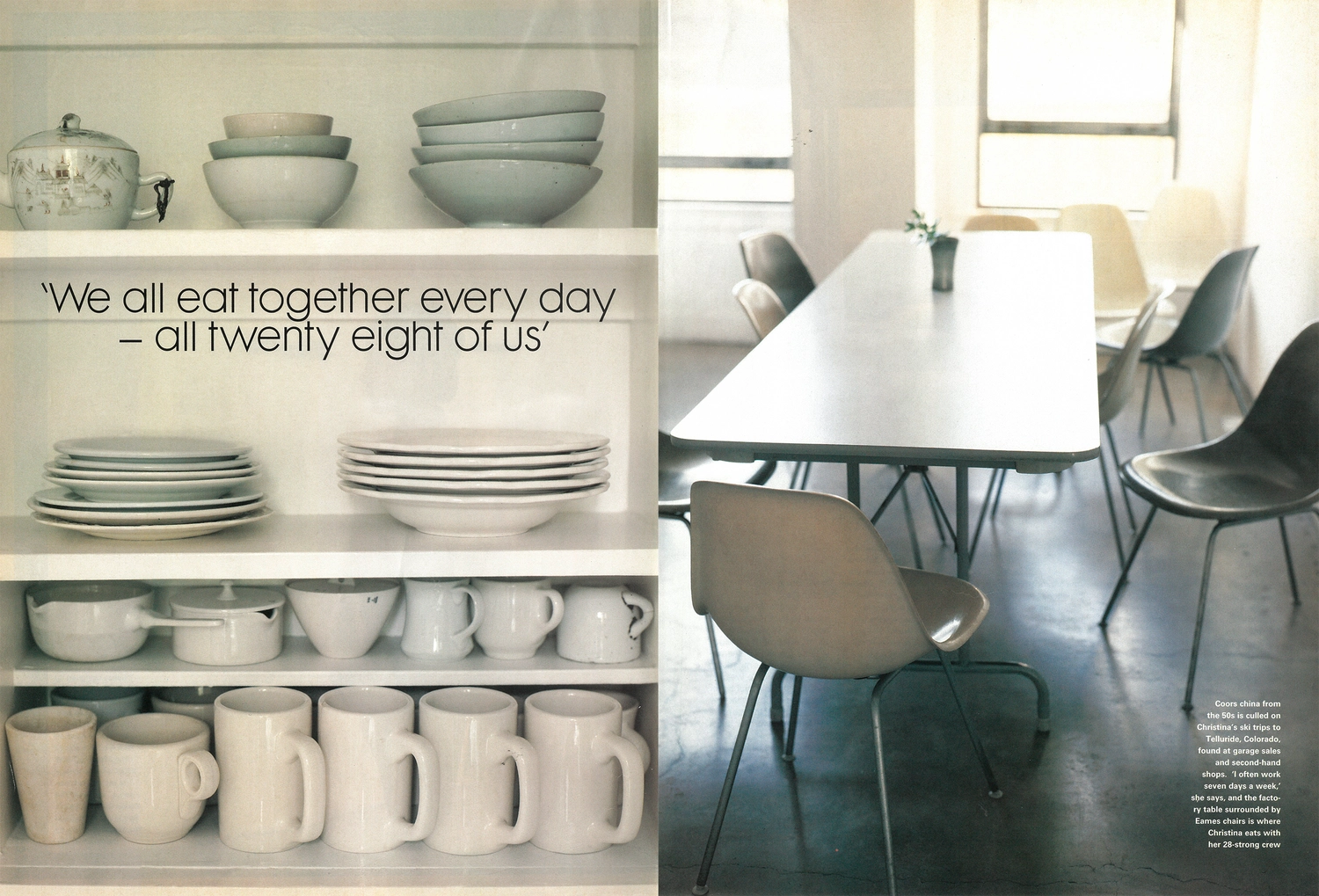
“All the fixtures, Formica worktop, and cupboards are built in, exactly the same now as when the house was built, in 1938,” says Christina. “It was so well-designed that you can put everything away, so that you don’t see any of the clutter.” Christina sourced the glasses from Haiti; both mugs and the white mugs from Hainan; both are available from Dosa by mail, as before.
She and Lindon Schultz, her boyfriend for the last 11 years, live in one of Richard Neutra’s prized houses. Built in 1938 by the Austrian architect, it sits high on a hill with a vast panoramic view of the city below. With just a sofa and several pouffes as furniture in her living room, she lives exactly as she says—minimalistically and modestly.
The walls of Christina’s home are bare, what surfaces exist are empty, and her bed is a mattress on the floor. “I wouldn’t say I was extravagant,” she says. “I’m comfortable, but my desires are not material. My house is tiny and my apartment in New York is really small, too. I don’t really like to go shopping. I wear ethnic clothes if I’m not wearing my own designs.
“I expect I probably I could afford more, but to be honest I don’t have the time. I work a lot—often seven days a week.”
When she does have any time for herself, Christina likes to work on a tiny ‘Mexican’ garden she is cultivating at the back of the house.
“Oh I do have one extravagance,” she adds. “I have two cars, one is a BMW 2800CS and the other is a 1959 Borgward Isabella, which is currently being restored…”
Her face lights up, her words accelerate and suddenly she is off again—clearly, this is another passion of hers.
PERSONAL FILE
Inspirational books? I am currently reading Garden Culture in the Ming Dynasty. And I love Paul Bowles' travel stories. I almost feel I'm tracking his footsteps sometimes.
Inspirational countries? Antarctica: I have never been to Antarctica but would love to go. I love the colours from there, all the different shades of the colour of ice.
Inspirational people? My grandmother inspired me hugely, and I had a great art teacher, Jacob Lawrence, when I was at college.
Favourite shops? Ted Muehling: He designs jewellery in New York. He is an amazing designer. I tend to buy a lot of ethnic clothing on my travels. But I don't really go shopping, except maybe to bookstores.
Favourite TV shows? I have a TV but I don't really watch it at all.
Favourite music: I really like a singer called Cesaria Evora. I tend to listen to ethnic music. I love Ryuichi Sakamoto, Ry Cooder, lots of music from around the world.
Favourite artist? Tim Hawkinson. He is a great LA artist and uses materials like no-one else ever. He has been very inspirational. Also Joseph Beuys, Robert Irwin and Richard Serra.
The Next Big Thing? I want to buy land, an orchard. One of the things I have noticed on my travels is the sense of smell. I would like to grow a garden that is really olfactory-orientated.
THE FACTORY
'Charlie Chaplin designed the building and it was owned by United Artists, Christina explains. Dosa started from one room on the seventh floor, expanding as Dosa grew, to take up the whole 12,000 sq ft floor. 'My boyfriend Lindon and I stripped everything bare, even took the ceilings back to their original height. We wanted it to be spacious and airy.' The home collection is meticulously laid out on original factory tables. Summer and Winter clothes collections rim the workroom on racks.
Interior architecture: Lindon Schultz (001 213 627 3672). Dosa home furnishings and clothes are available from The Cross (0171 727 6760), Browns (0171 495 1509) and by mail order (001 213 627 3672). Metal factory tables are leftovers from the LA defence industry which went out of business in the 30s, from Rubbish (001 213 661 5575).
text: Lucy Broadbent
photo: Don Freeman
producer: Deborah Morant