Financial Times Weekend Magazine
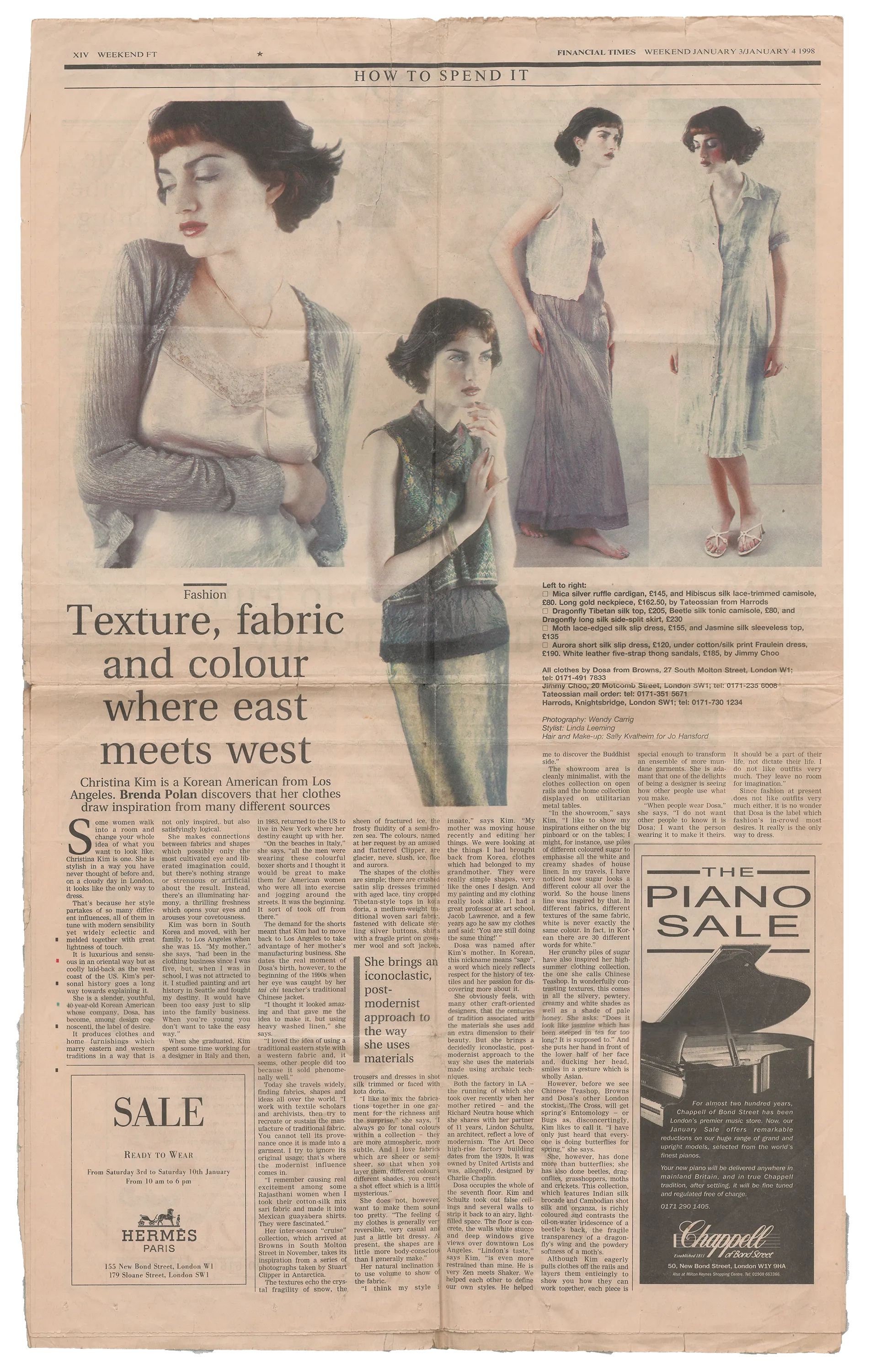
Texture, fabric and colour where east meets west
January 3, 1998
"Christina Kim is a Korean American from Los Angeles. Brenda Polan discovers that her clothes draw inspiration from many different sources"
Some women walk into a room and change your whole idea of what you want to look like. Christina Kim is one. She is stylish in a way you have never thought of before and, on a cloudy day in London, it looks like the only way to dress.
That’s because her style partakes of so many different influences, all of them in tune with modern sensibility yet widely eclectic and melded together with great lightness of touch. It is luxurious and sensuous in an oriental way but as coolly laid-back as the west coast of the US. Kim’s personal history goes a long way towards explaining it.
She is a slender, youthful, 40-year-old Korean American whose company, Dosa, has become, among design cognoscenti, the label of desire.
It produces clothes and home furnishings which marry eastern and western traditions in a way that is not only inspired, but also satisfyingly logical.
She makes connections between fabrics and shapes which possibly only the most cultivated eye and liberated imagination could, but there’s nothing strange or strenuous or artificial about the result. Instead, there’s an illuminating harmony, a thrilling freshness which opens your eyes and arouses your covetousness.
Kim was born in South Korea and moved, with her family, to Los Angeles when she was 15. “My mother,” she says, “had been in the clothing business since I was five, but, when I was in school, I was not attracted to it. I studied painting and art history in Seattle and fought my destiny. It would have been too easy just to slip into the family business. When you’re young you don’t want to take the easy way.”
When she graduated, Kim spent some time working for a designer in Italy and then, in 1983, returned to the US to live in New York where her destiny caught up with her.
“On the beaches in Italy,” she says, “all these men were wearing these colourful boxer shorts and I thought it would be great to make them for American women who were all into exercise and jogging around the streets. It was the beginning. It sort of took off from there.”
The demand for the shorts meant that Kim had to move back to Los Angeles to take advantage of her mother’s manufacturing business. She dates the real moment of Dosa’s birth, however, to the beginning of the 1990s when her eye was caught by her tai chi teacher’s traditional Chinese jacket.
“I thought it looked amazing and that gave me the idea to make it, but using heavy washed linen,” she says.
“I loved the idea of using a traditional eastern style with a western fabric and, it seems, other people did too because it sold phenomenally well.”
Today she travels widely, finding fabrics, shapes and ideas all over the world. “I work with textile scholars and archivists, then try to recreate or sustain the manufacture of traditional fabric. You cannot tell its provenance once it is made into a garment. I try to ignore its original usage: that’s where the modernist influence comes in.
“I remember causing real excitement among some Rajasthani women when I took their cotton-silk mix sari fabric and made it into Mexican huayabera shirts. They were fascinated.”
Her inter-season “cruise” collection, which arrived at Browns in South Molton Street in November, takes its inspiration from a series of photographs taken by Stuart Clipper in Antarctica.
The textures echo the crystal fragility of snow, the sheen of fractured ice, the frosty fluidity of a semi-frozen sea. The colours, named at her request by an amused and flattered Clipper, are glacier, neve, slush, ice, floe, and aurora.
The shapes of the clothes are simple; there are crushed satin slip dresses trimmed with aged lace, tiny cropped Tibetan-style tops in kora doria, a medium-weight traditional woven sari fabric, fastened with delicate sterling silver buttons, shirts with a fragile print on gossamer wool and soft jackets, trousers and dresses in shot silk trimmed or faced with kota doria.
“I like to mix the fabrications together in one garment for the richness and the surprise,” she says, “I always go for tonal colours within a collection – they are more atmospheric, more subtly. And I love fabrics which are sheer or semi-sheer, so that when you layer them, different colours, different shades, you create a shot effect which is a little mysterious.”
She does not, however, want to make them sound too pretty. “The feeling of my clothes is generally very reversible, very casual and just a little bit dressy. At present, the shapes are a little more body-conscious than I generally make.”
Her natural inclination is to use volume to show off the fabric.
“I think my style is innate,” says Kim. “My mother was moving house recently and editing her things. We were looking at the things I had brought back from Korea, clothes which had belonged to my grandmother. They were really simple shapes, very like the ones I design. And my painting and my clothing really look alike. I had a great professor at art school, Jacob Lawrence, and a few years ago he saw my clothes and said: ‘You are still doing the same thing!’”
Dosa was named after Kim’s mother. In Korean, this nickname means “sage”, a word twitch nicely reflects respect for the history of textiles and her passion for discovering more about it.
She obviously feels, with many other craft-oriented designers, that the centuries of tradition associated with the materials she uses add an extra dimension to their beauty. But she brings a decidedly iconoclastic, post-modernist approach to the way she uses the materials made using archaic techniques.
Both the factory in LA – the running of which she took over recently when her mother retired – and the Richard Neutra house which she shares with her partner of 11 years, Lindon Schultz, an architect, reflect a love of modernism. The Art Deco high-rise factory building dates from the 1920s. It was owned by United Artists and was, allegedly, designed by Charlie Chaplin.
Dosa occupies the whole of the seventh floor. Kim and Schultz took out false ceilings and several walls to strip it back to an airy, light-filled space. The floor is concrete, the walls white stucco and deep windows give views over downtown Los Angeles. “Lindon’s taste,” says Kim, “is even more restrained than mine. He is very Zen meets Shaker. We helped each other to define our own styles. He helped me to discover the Buddhist side.”
The showroom area is cleanly minimalist, with the clothes collection on open rails and the home collection displayed on utilitarian metal tables.
“In the showroom,” says Kim, “I like to show my inspirations either on the big pinboard or on the tables; I might, for instance, use piles of different coloured sugar to emphasise all the white and creamy shades of house linen. In my travels, I have noticed how sugar looks a different colour all over the world. So the house linens line was inspired by that. In different fabrics, different textures of the same fabric, white is never exactly the same colour. In fact, in Korean there are 30 different words for white.”
Her crunchy piles of sugar have also inspired her high-summer clothing collection, the one she calls Chinese Teashop. In wonderfully contrasting textures, this comes in all the silvery, pewtery, creamy and white shades as well as a shade of pale honey. She asks: “Does it look like jasmine which has been steeped in tea for too long? It is supposed to.” And she puts her hand in front of the lower half of her face and, ducking her head, smiles in a gesture which is wholly Asian.
However, before we see Chinese Teashop, Browns and Dosa’s other London stockist, The Cross, will get spring’s Entomology – or Bugs as, disconcertingly, Kim likes to call it. “I have only just heard that everyone is doing butterflies for spring,” she says.
She, however, has done more than butterflies; she has also done beetles, dragonflies, grasshoppers, moths and crickets. This collection, which features Indian silk brocade and Cambodian shot silk and organza, is richly coloured and contrasts the oil-on-water iridescence of a beetle’s back, the fragile transparency of a dragonfly’s wing and the powdery softness of a moth’s.
Although Kim eagerly pulls clothes off the rails and layers them enticingly to show you how they can work together, each piece is special enough to transform an ensemble of more mundane garments. She is adamant that one of the delights of being a designer is seeing how other people use what you make.
“When people wear Dosa,” she says, “I do not want other people to know it is Dosa; I want the person wearing it to make it theirs. It should be a part of their life, not dictate their life. I do not like outfits very much. They leave no room for imagination.”
Since fashion at present does not like outfits very much either, it is no wonder that Dosa is the label which fashion’s in-crowd most desires. It really is the only way to dress.
text: Brenda Polan
photo: Wendy Carrig
stylist: Linda Leeming
hair and make-up: Sally Kvalheim for Jo Hansford