Organic Style
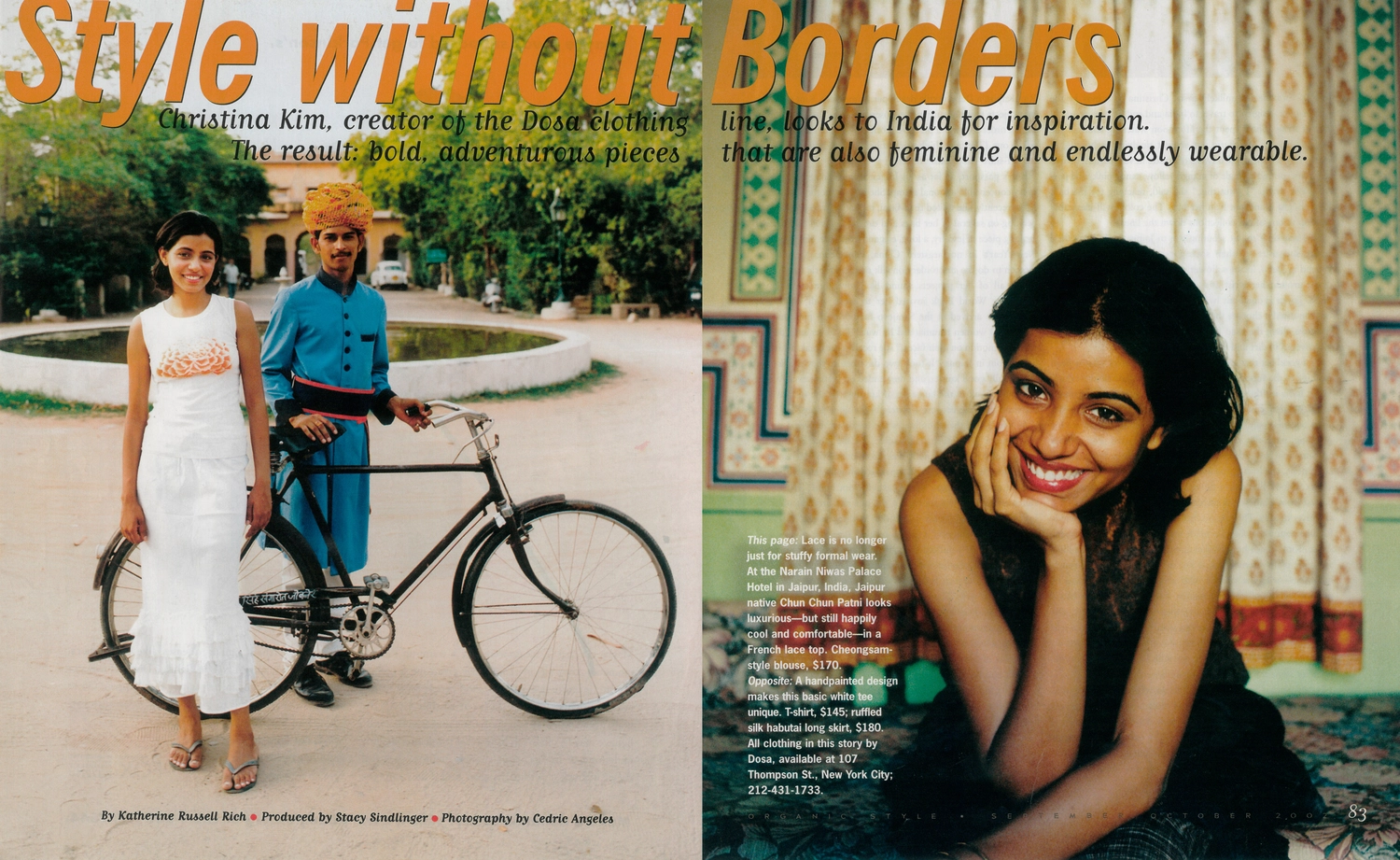
Style without Borders
September/October 2002
"Taking inspiration from the traditional fabrics and bold colors of India, Christina Kim, of dosa, creates modern and wearable clothing."
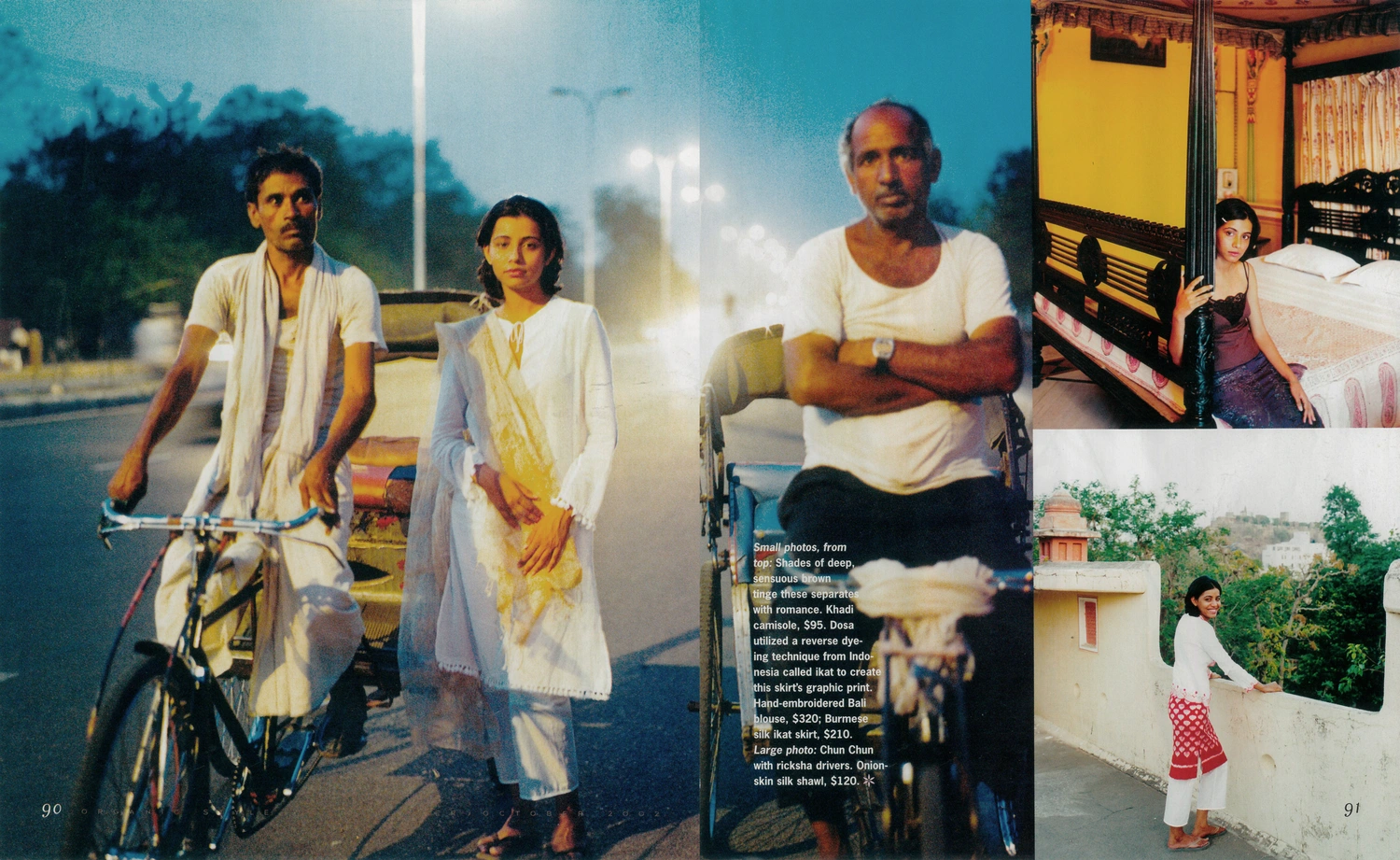
In a life notable for unlikely firsts, Christina Kim may be the first fashion designer to travel to India and end up buying an old ball of string. She'd spent the afternoon watching some of the last practioners of laharia, an ancient tie-dying technique, at work. As the men slapped twists of cotton in vats of dark brown dye, Kim spotted a tangle of mango yellow, candy pink, and parrot green string. "I want this," she said, reaching for the ball. Kim bought it and put it in her bag. The colors will inevitably turn up in one of her collections down the line.
This was on a recent scouting trip to Jaipur, an Indian fabric center she visits so often she's got a travel routine: Hit the ground in Delhi, locate a flower stall, buy strands of jasmine to drape around her wrist and, if she's hired a car, decorate its hood. Jaipur is one hour by plane and a rattly six hours by car, but she usually chooses the drive. "My favorite part of India is the trees along the road from Delhi," she says. "The ones that are covered in dirt and look like lace."
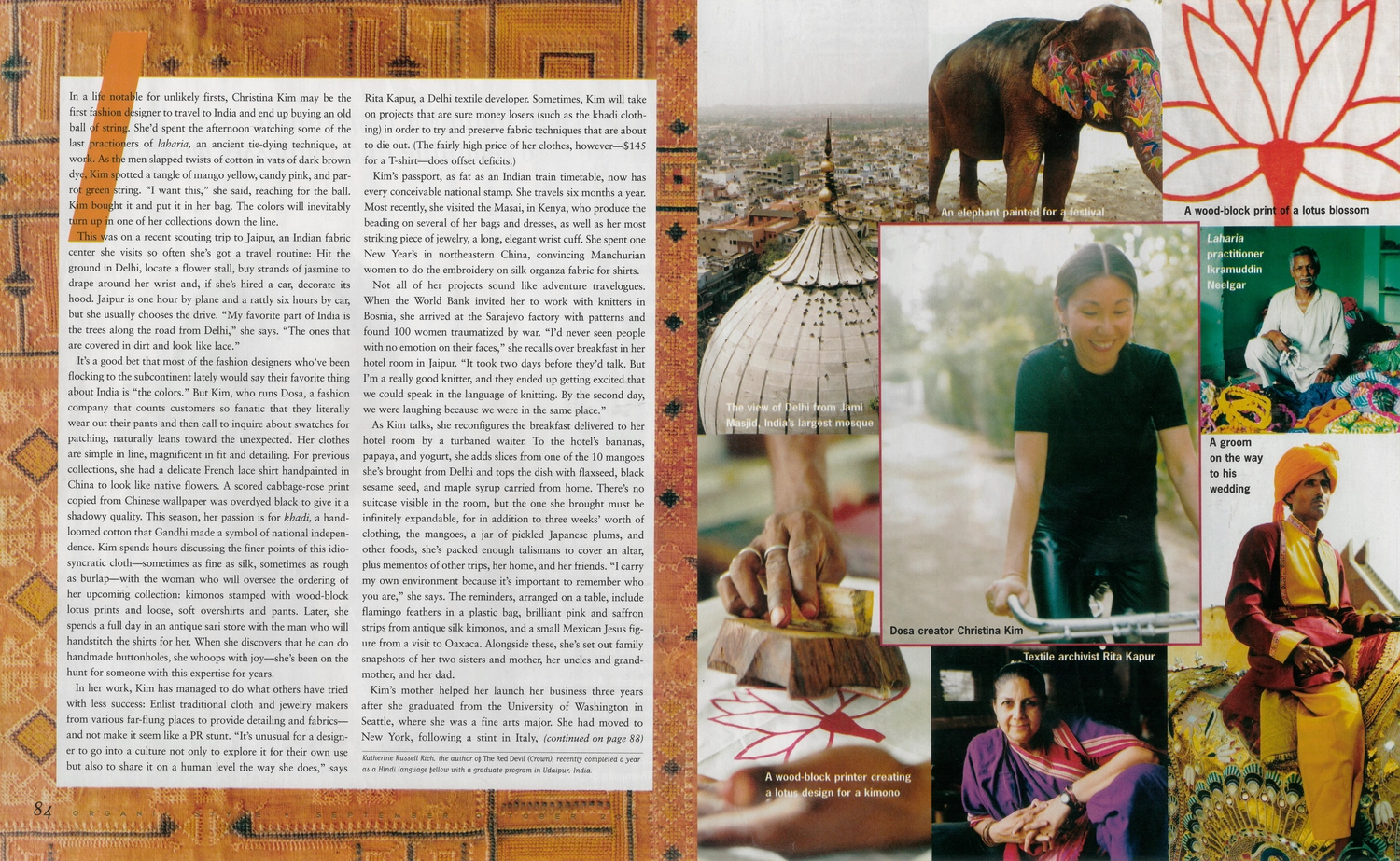
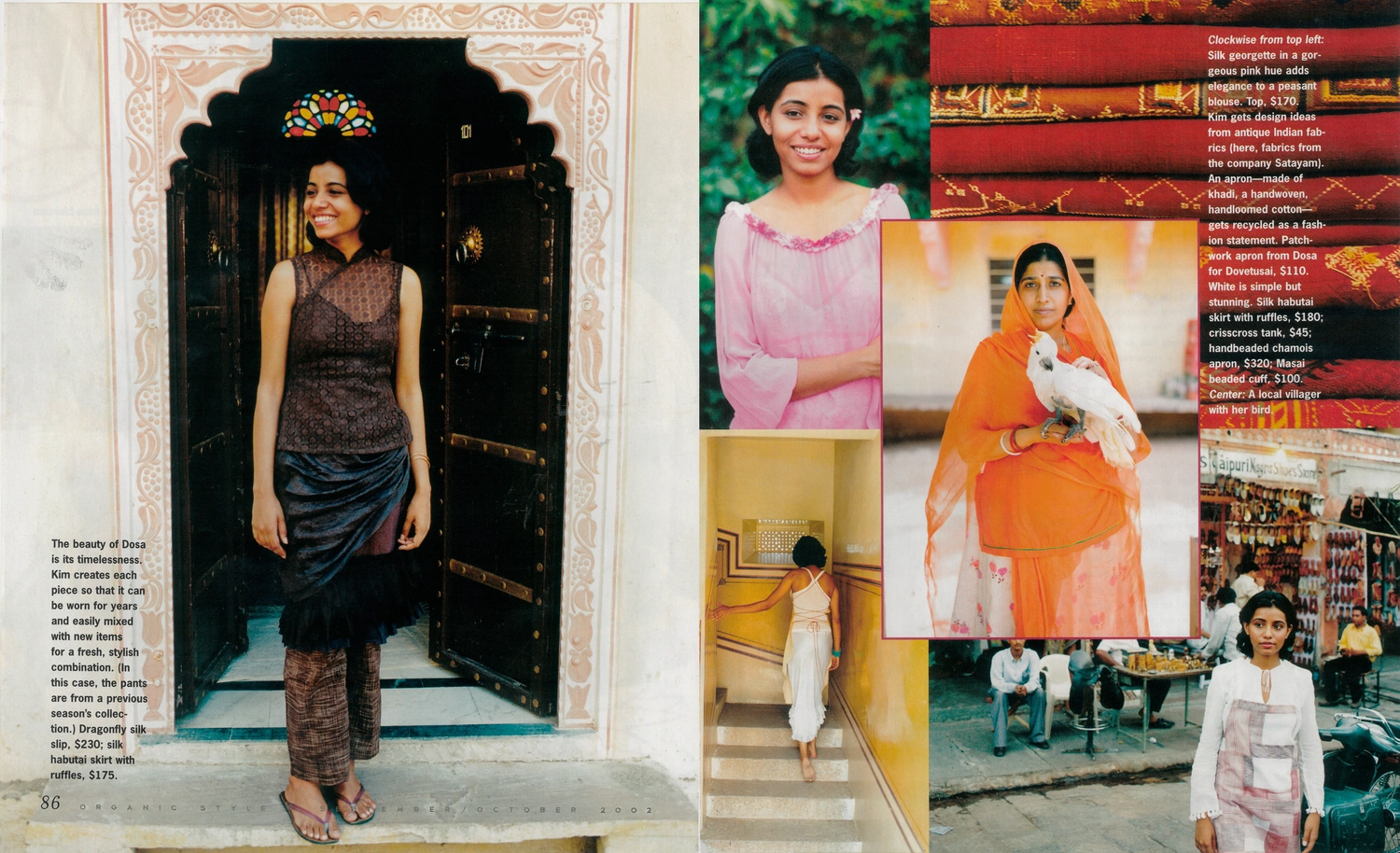
It's a good bet that most of the fashion designers who've been flocking to the subcontinent lately would say their favorite thing about India is "the colors." But Kim, who runs Dosa, a fashion company that counts customers so fanatic that they literally wear out their pants and then call to inquire about swatches for patching, naturally leans toward the unexpected. Her clothes are simple in line, magnificent in fit and detailing. For previous collections, she had a delicate French lace shirt handpainted in China to look like native flowers. A scored cabbage-rose print copied from Chinese wallpaper was overdyed black to give it a shadowy quality. This season, her passion is for khadi, a handloomed cotton that Gandhi made a symbol of national independence. Kim spends hours discussing the finer points of this idiosyncratic cloth—sometimes as fine as silk, sometimes as rough as burlap—with the woman who will oversee the ordering of her upcoming collection: kimonos stamped with wood-block lotus prints and loose, soft overshirts and pants. Later, she spends a full day in an antique sari store with the man who will handstitch the shirts for her. When she discovers that he can do handmade buttonholes, she whoops with joy—she's been on the hunt for someone with this expertise for years.
In her work, Kim has managed to do what others have tried with less success: Enlist traditional cloth and jewelry makers from various far-flung places to provide detailing and fabrics— and not make it seem like a PR stunt. "It's unusual for a designer to go into a culture not only to explore it for their own use but also to share it on a human level the way she does," says Rita Kapur, a Delhi textile developer. Sometimes, Kim will take on projects that are sure money losers (such as the khadi clothing) in order to try and preserve fabric techniques that are about to die out. (The fairly high price of her clothes, however—$145 for a T-shirt—does offset deficits.)
Kim's passport, as fat as an Indian train timetable, now has every conceivable national stamp. She travels six months a year. Most recently, she visited the Masai, in Kenya, who produce the beading on several of her bags and dresses, as well as her most striking piece of jewelry, a long, elegant wrist cuff. She spent one New Year's in northeastern China, convincing Manchurian women to do the embroidery on silk organza fabric for shirts.
Not all of her projects sound like adventure travelogues. When the World Bank invited her to work with knitters in Bosnia, she arrived at the Sarajevo factory with patterns and found 100 women traumatized by war. "I'd never seen people with no emotion on their faces," she recalls over breakfast in her hotel room in Jaipur. "It took two days before they'd talk. But I'm a really good knitter, and they ended up getting excited that we could speak in the language of knitting. By the second day, we were laughing because we were in the same place."
As Kim talks, she reconfigures the breakfast delivered to her hotel room by a turbaned waiter. To the hotel's bananas, papaya, and yogurt, she adds slices from one of the 10 mangoes she's brought from Delhi and tops the dish with flaxseed, black sesame seed, and maple syrup carried from home. There's no suitcase visible in the room, but the one she brought must be infinitely expandable, for in addition to three weeks' worth of clothing, the mangoes, a jar of pickled Japanese plums, and other foods, she's packed enough talismans to cover an altar, plus mementos of other trips, her home, and her friends. "I carry my own environment because it's important to remember who you are," she says. The reminders, arranged on a table, include flamingo feathers in a plastic bag, brilliant pink and saffron strips from antique silk kimonos, and a small Mexican Jesus figure from a visit to Oaxaca. Alongside these, she's set out family snapshots of her two sisters and mother, her uncles and grandmother, and her dad.
Kim's mother helped her launch her business three years after she graduated from the University of Washington in Seattle, where she was a fine arts major. She had moved to New York, following a stint in Italy, and discovered some Liberty print fabric she thought would make cool boxer shorts. Bendel's department store instantly bought 24 pairs, sold out in two days, and wanted 100 more. Within a week, she couldn't keep up with the demand. Her mother, whose nickname is Dosa, or "sage" in Korean, was then starting her own clothing line in Los Angeles. Kim called her. "She just said, 'Come to L.A.,'" Kim says, and she did.
That was in 1983. As Dosa comes up on its 20th anniversary, Kim's clothes are being sold in 100 stores and 20 different countries, despite the fact that "she spends most of her time trying not to expand," according to a saleswoman in her SoHo, New York, store. In an age when executives employ their own publicists, she's a rarity: the owner of a hugely successful company whose ego isn't on a rampage. In Los Angeles, where she lives in a minimalist house designed by an ex-boyfriend, an architect, her own life is spare: She rises each morning at 5:30 to play tennis, puts in 12 hours, is in bed by 10.
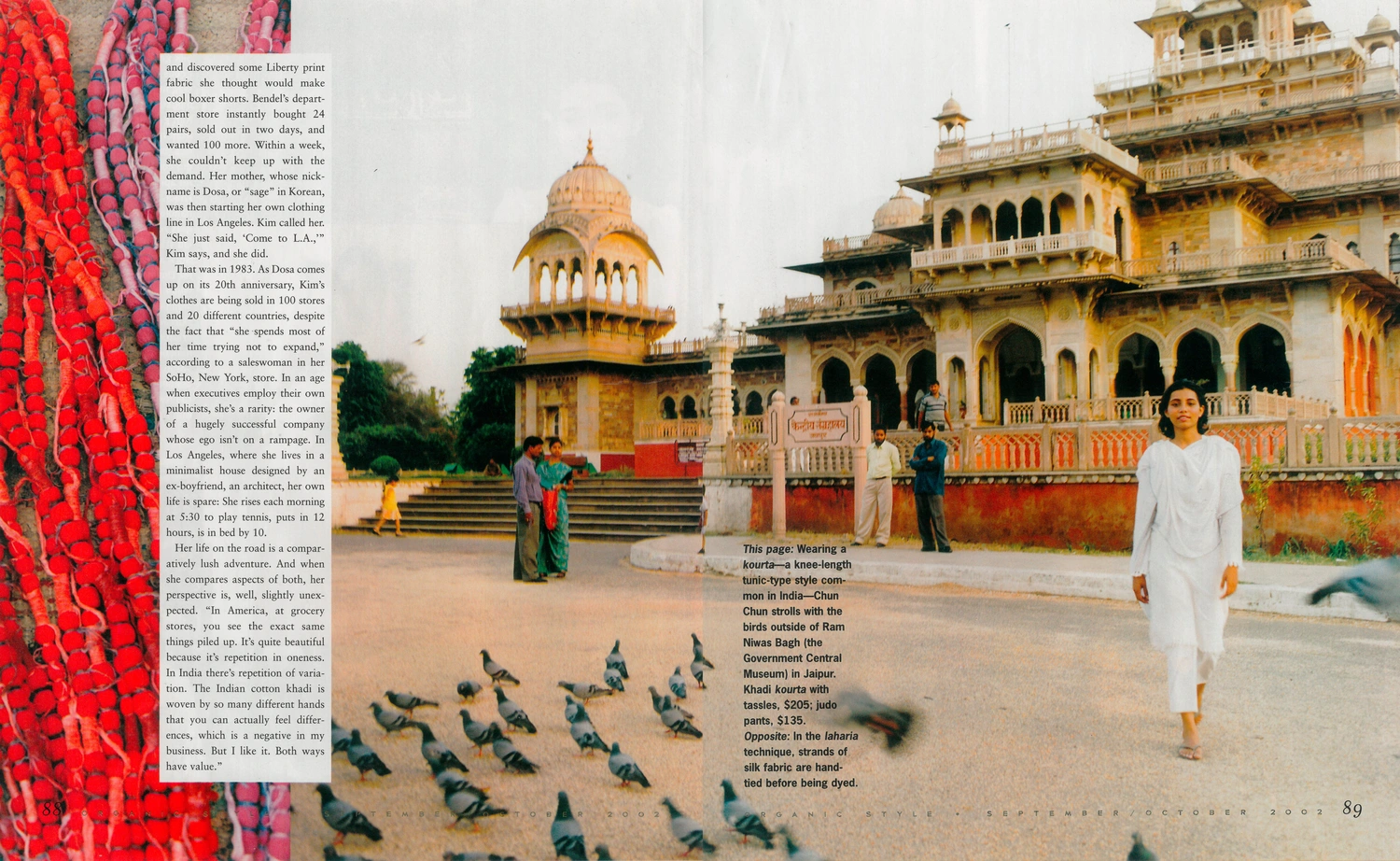
Her life on the road is a comparatively lush adventure. And when she compares aspects of both, her perspective is, well, slightly unexpected. "In America, at grocery stores, you see the exact same things piled up. It's quite beautiful because it's repetition in oneness. In India there's repetition of variation. The Indian cotton khadi is woven by so many different hands that you can actually feel differences, which is a negative in my business. But I like it. Both ways have value."
text: Katherine Russell Rich
photo: Cedric Angeles
producer: Stacy Sindlinger