Selvedge
Khadi: the freedom fabric & dosa: deliberately different
July/August 2004
"Brinda Gill unravels the history of this versatile and enduring cloth. Plus the subtle qualities of designer Christina Kim and her work in khadi."
Khadi: the freedom fabric
HOW CLOTH BECAME THE SYMBOL OF A NATION'S STRUGGLE
It is a thread that slips through centuries of Indian history and across the vast sub-continent. Born from nature, spun and woven by the hands of man, cotton threads have provided employment, provoked philosophical ponderings and political plots. It's a long haul for a modest yarn that begins life as a soft puff, is spun into the lightest of threads and then woven into a range of fabrics. Khadi is made into a variety of weights some so fine that a full width will pass through a finger ring, some so tough that they can be used as floor coverings or tents and passed down for generations.
It is these fabrics, hand woven from hand spun threads and known as khadi, for which India has been famous since ancient times. Their creation embraces a painstaking labour intensive process: cotton is hand picked, hand ginned to separate the seeds from the fibres, hand spun with spindles or spinning wheels and then hand woven. Embellishments in the form of hand painting, printing, dyeing and embroidery extend the fabric's natural beauty.
For centuries, fine khadi textiles were created in India without the necessity of machines. Spinning skills passed down from mother to daughter, weaving skills from father to son, ensured the continuity and perfection of a skill and a trade where weavers were thought of as 'magicians'. Descriptions, apt and poetic, conveyed the beauty of the texture, colours and pattern of textiles: evening dew for a fabric that seemed to melt away when spread on grass, running water for another that became imperceptible when dipped in water; woven air for one that was particularly diaphanous. In fact, in the 1st century AD imports from India, including muslins, cost Rome 50 million sesterces annually, causing a distressed Pliny to remark: 'So dearly do we pay for our luxury and our women!' In later centuries, Indian textiles were an accepted commodity used for barter in the lucrative spice trade that spanned the Indian Ocean.
But India's position grew tenuous as the industrial revolution gathered steam. Cloth made in England began to fill Indian markets; from being a producer of the finest fabrics, India was now forced to export raw cotton and buy cloth produced in the mills of Manchester. With the influx of inexpensive cloth that was easy to maintain, weavers lost their livelihood. Left without the means to sustain themselves, when famine or natural calamity struck they died in their hundreds. In the mid-19th century, Lord William Bentinck, Governor General of India, bewailed their predicament: 'The bones of cotton weavers are bleaching the plains of India'.
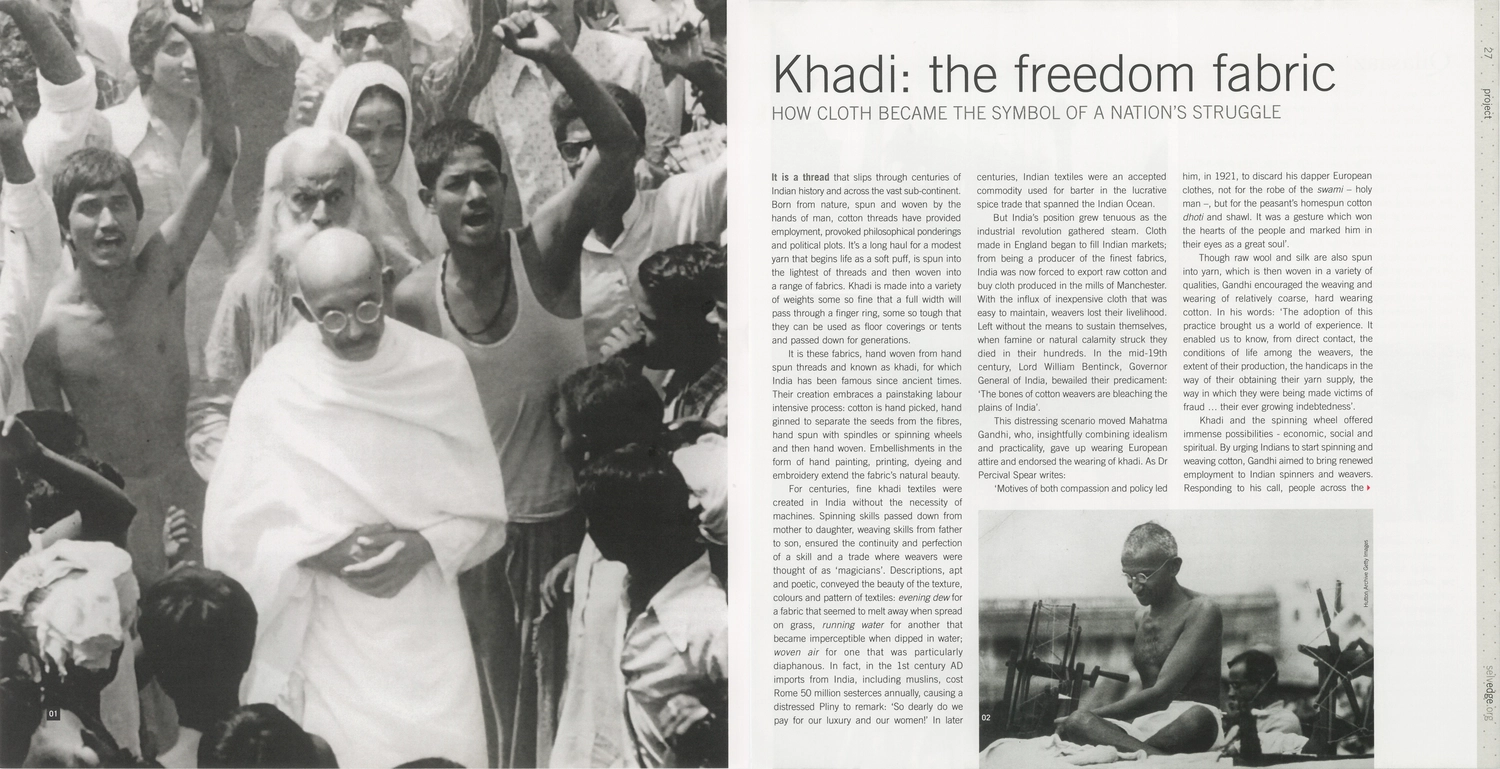
This distressing scenario moved Mahatma Gandhi, who, insightfully combining idealism and practicality, gave up wearing European attire and endorsed the wearing of khadi. As Dr Percival Spear writes:
'Motives of both compassion and policy led him, in 1921, to discard his dapper European clothes, not for the robe of the swami—holy man—, but for the peasant's homespun cotton dhoti and shawl. It was a gesture which won the hearts of the people and marked him in their eyes as a great soul'.
Though raw wool and silk are also spun into yarn, which is then woven in a variety of qualities, Gandhi encouraged the weaving and wearing of relatively coarse, hard wearing cotton. In his words: 'The adoption of this practice brought us a world of experience. It enabled us to know, from direct contact, the conditions of life among the weavers, the extent of their production, the handicaps in the way of their obtaining their yarn supply, the way in which they were being made victims of fraud … their ever growing indebtedness'.
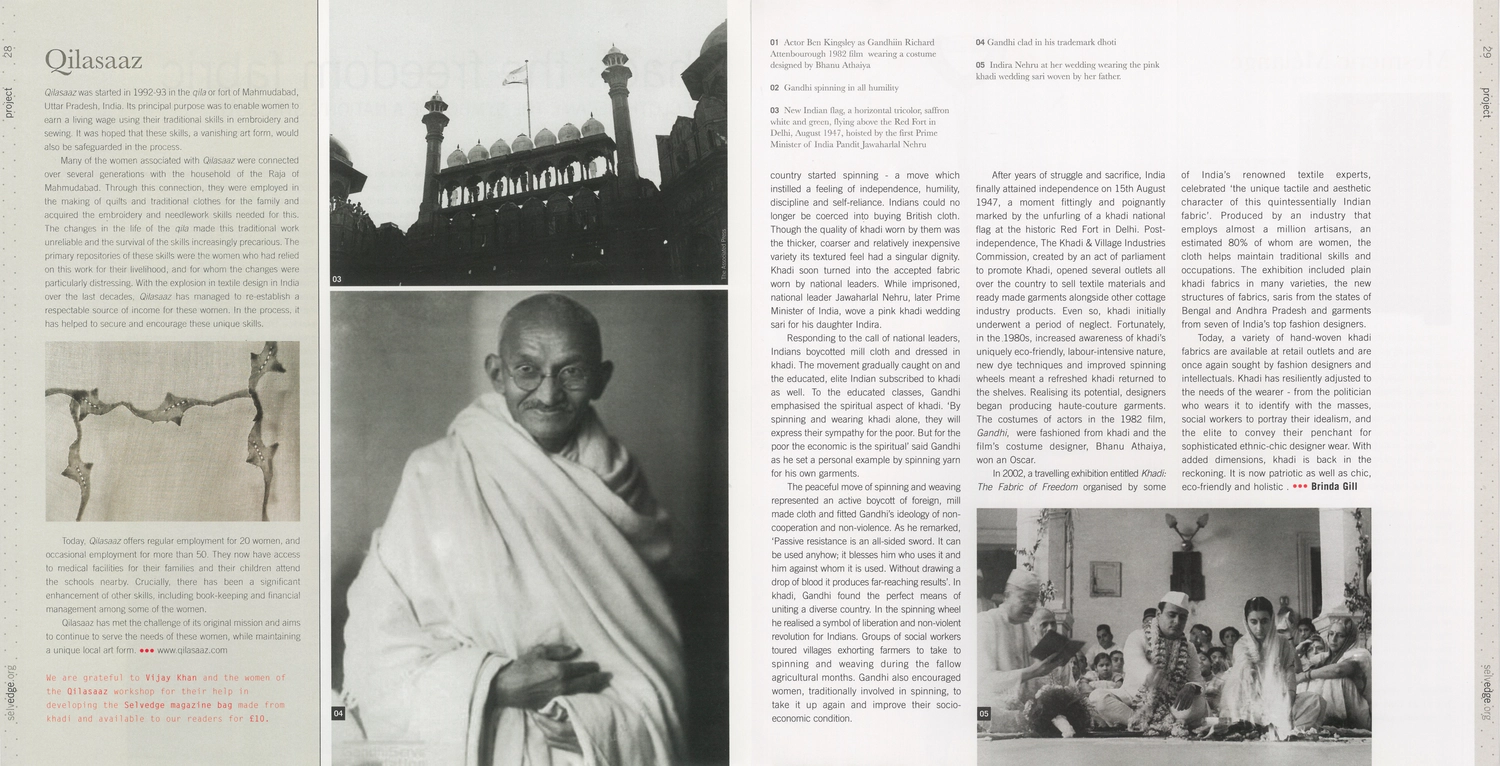
The spinning wheel offered immense possibilities - economic, social and spiritual. By urging Indians to start spinning and weaving cotton, Gandhi aimed to bring renewed employment to Indian spinners and weavers. Responding to his call, people across the country started spinning—a move which instilled a feeling of independence, humility, discipline and self-reliance. Indians could no longer be coerced into buying British cloth. Though the quality of khadi worn by them was the thicker, coarser and relatively inexpensive variety its textured feel had a singular dignity. Khadi soon turned into the accepted fabric worn by national leaders. While imprisoned, national leader Jawaharlal Nehru, later Prime Minister of India, wove a pink khadi wedding sari for his daughter Indira.
Responding to the call of national leaders, Indians boycotted mill cloth and dressed in khadi. The movement gradually caught on and the educated, elite Indian subscribed to khadi as well. To the educated classes, Gandhi emphasised the spiritual aspect of khadi. 'By spinning and wearing khadi alone, they will express their sympathy for the poor. But for the poor the economic is the spiritual' said Gandhi as he set a personal example by spinning yarn for his own garments.
The peaceful move of spinning and weaving represented an active boycott of foreign, mill made cloth and fitted Gandhi's ideology of non-cooperation and non-violence. As he remarked, 'Passive resistance is an all-sided sword. It can be used anyhow; it blesses him who uses it and him against whom it is used. Without drawing a drop of blood it produces far-reaching results'. In khadi, Gandhi found the perfect means of uniting a diverse country. In the spinning wheel he realised a symbol of liberation and non-violent revolution for Indians. Groups of social workers toured villages exhorting farmers to take to spinning and weaving during the fallow agricultural months. Gandhi also encouraged women, traditionally involved in spinning, to take it up again and improve their socio-economic condition.
After years of struggle and sacrifice, India finally attained independence on 15th August 1947, a moment fittingly and poignantly marked by the unfurling of a khadi national flag at the historic Red Fort in Delhi. Post-independence, The Khadi & Village Industries Commission, created by an act of parliament to promote Khadi, opened several outlets all over the country to sell textile materials and ready made garments alongside other cottage industry products. Even so, khadi initially underwent a period of neglect. Fortunately, in the 1980s, increased awareness of khadi's uniquely eco-friendly, labour-intensive nature, new dye techniques and improved spinning wheels meant a refreshed khadi returned to the shelves. Realising its potential, designers began producing haute-couture garments. The costumes of actors in the 1982 film, Gandhi, were fashioned from khadi and the film's costume designer, Bhanu Athaiya, won an Oscar.
In 2002, a travelling exhibition entitled Khadi: The Fabric of Freedom organised by some of India's renowned textile experts, celebrated 'the unique tactile and aesthetic character of this quintessentially Indian fabric'. Produced by an industry that employs almost a million artisans, an estimated 80% of whom are women, the cloth helps maintain traditional skills and occupations. The exhibition included plain khadi fabrics in many varieties, the new structures of fabrics, saris from the states of Bengal and Andhra Pradesh and garments from seven of India's top fashion designers.
Today, a variety of hand-woven khadi fabrics are available at retail outlets and are once again sought by fashion designers and intellectuals. Khadi has resiliently adjusted to the needs of the wearer - from the politician who wears it to identify with the masses, social workers to portray their idealism, and the elite to convey their penchant for sophisticated ethnic-chic designer wear. With added dimensions, khadi is back in the reckoning. It is now patriotic as well as chic, eco-friendly and holistic.
Dosa: deliberately different
CHRISTINA KIM'S CAREFULLY CRAFTED CLOTHES
The term 'craft' has recently been rejected by several important American institutions, in particular the former American Crafts Museum, but it is difficult to explain why the term has been so roundly rebuffed. At the same time as the term is being erased from institutional titles and spurned by artists, it is also evident that its associations and values are experiencing a renaissance.
The 9/11 terrorist attacks have been cited as a factor in the return to favour of the handmade. It is believed that the precarious nature of world relations has revived the more homely nesting instincts in us. Fashion and interior decorating have discovered textiles featuring details produced by the human hand. Needless to say, however, craft's return to favour is far from straightforward. Craft has returned as an inspiration and reference for today's designers, but does not necessarily permeate production methods. The chunky, hand knitted sweater may have been part of winter fashion, but on the high street production remains mechanical; in many ways an ironic simulacrum rather than a reality of what crafts embody.
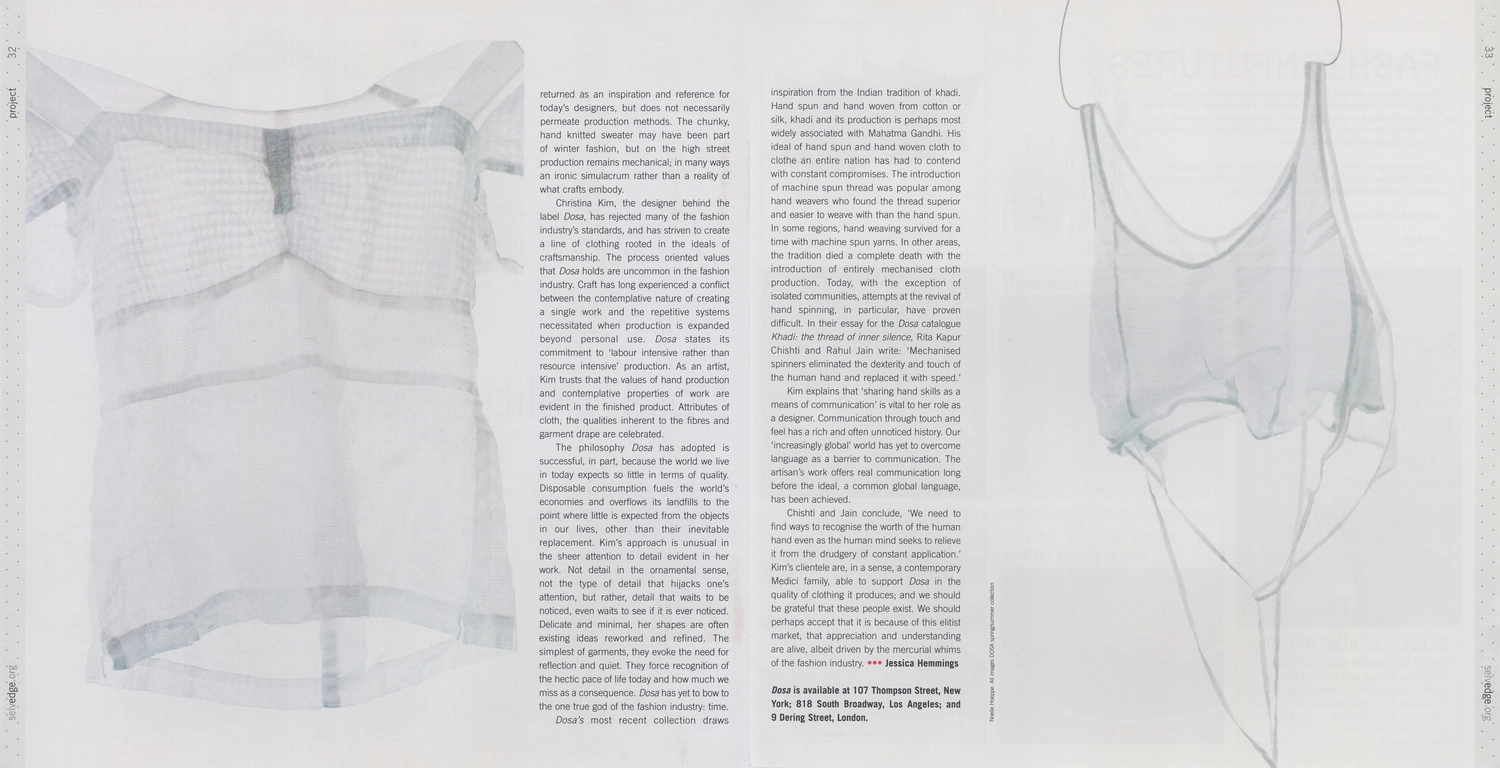
Christina Kim, the designer behind the label Dosa, has rejected many of the fashion industry's standards, and has striven to create a line of clothing rooted in the ideals of craftsmanship. The process oriented values that Dosa holds are uncommon in the fashion industry. Craft has long experienced a conflict between the contemplative nature of creating a single work and the repetitive systems necessitated when production is expanded beyond personal use. Dosa states its commitment to 'labour intensive rather than resource intensive' production. As an artist, Kim trusts that the values of hand production and contemplative properties of work are evident in the finished product. Attributes of cloth, the qualities inherent to the fibres and garment drape are celebrated.
The philosophy Dosa has adopted is successful, in part, because the world we live in today expects so little in terms of quality. Disposable consumption fuels the world's economies and overflows its landfills to the point where little is expected from the objects in our lives, other than their inevitable replacement. Kim's approach is unusual in the sheer attention to detail evident in her work. Not detail in the ornamental sense, not the type of detail that hijacks one's attention, but rather, detail that waits to be noticed, even waits to see if it is ever noticed. Delicate and minimal, her shapes are often existing ideas reworked and refined. The simplest of garments, they evoke the need for reflection and quiet. They force recognition of the hectic pace of life today and how much we miss as a consequence. Dosa has yet to bow to the one true god of the fashion industry: time.
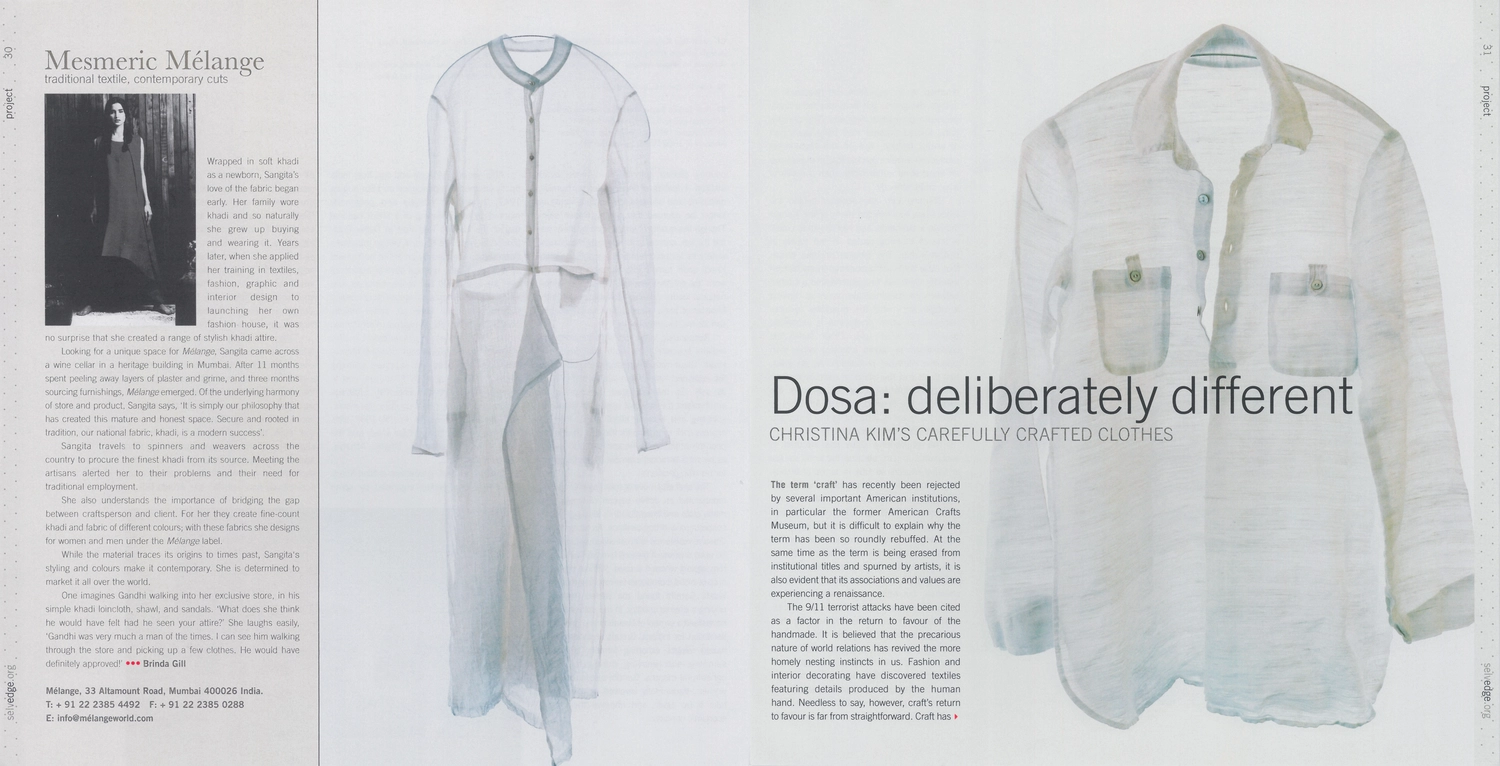
Dosa's most recent collection draws inspiration from the Indian tradition of khadi. Hand spun and hand woven from cotton or silk, khadi and its production is perhaps most widely associated with Mahatma Gandhi. His ideal of hand spun and hand woven cloth to clothe an entire nation has had to contend with constant compromises. The introduction of machine spun thread was popular among hand weavers who found the thread superior and easier to weave with than the hand spun. In some regions, hand weaving survived for a time with machine spun yarns. In other areas, the tradition died a complete death with the introduction of entirely mechanised cloth production. Today, with the exception of isolated communities, attempts at the revival of hand spinning, in particular, have proven difficult. In their essay for the Dosa catalogue Khadi: the thread of inner silence, Rita Kapur Chishti and Rahul Jain write: 'Mechanised spinners eliminated the dexterity and touch of the human hand and replaced it with speed.'
Kim explains that 'sharing hand skills as a means of communication' is vital to her role as a designer. Communication through touch and feel has a rich and often unnoticed history. Our 'increasingly global' world has yet to overcome language as a barrier to communication. The artisan's work offers real communication long before the ideal, a common global language, has been achieved.
Chishti and Jain conclude, 'We need to find ways to recognise the worth of the human hand even as the human mind seeks to relieve it from the drudgery of constant application.' Kim's clientele are, in a sense, a contemporary Medici family, able to support Dosa in the quality of clothing it produces; and we should be grateful that these people exist. We should perhaps accept that it is because of this elitist market, that appreciation and understanding are alive, albeit driven by the mercurial whims of the fashion industry.
text: Brinda Gill (on khadi) and Jessica Hemmings (on dosa)
photo: Noelle Hoeppe