Subsequence
Hanbok Revisited: Interview with Christina Kim of dosa
June 2024
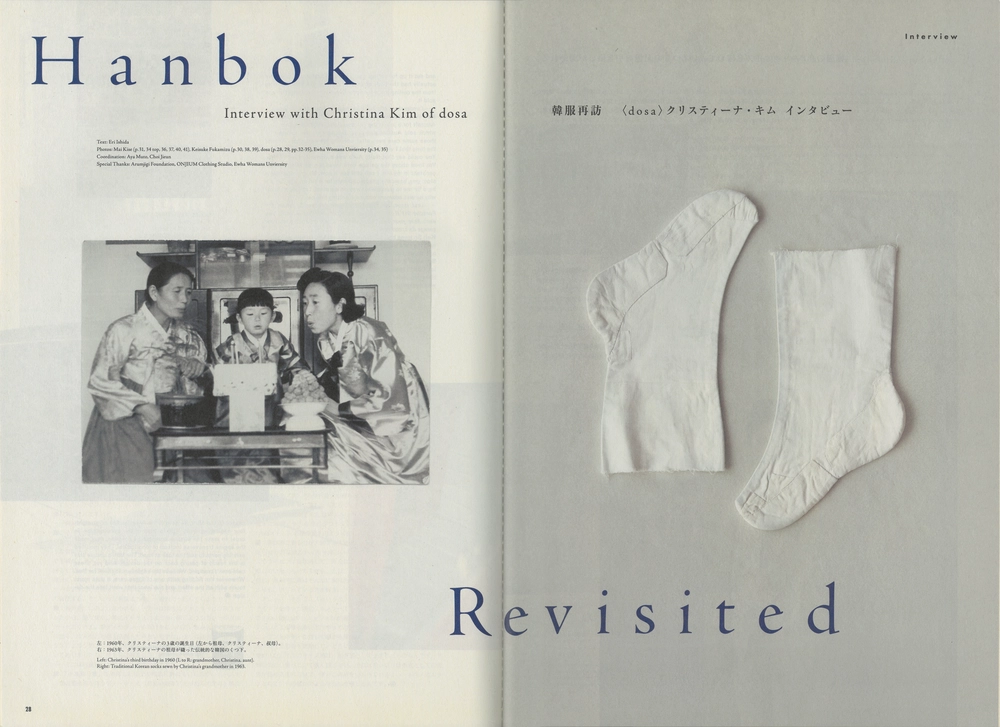
Born in Seoul in 1957, four years after the end of the Korean War, my first memories are of preparing traditional Korean meals with my grandmother, dressed in Korean clothing, in an earthen floor hanok, the traditional Korean-style house... My work has always been informed by bits and pieces of memory, particularly by what I learned as a child in Korea. Cooking, sewing, gardening—acts of making with our hands.
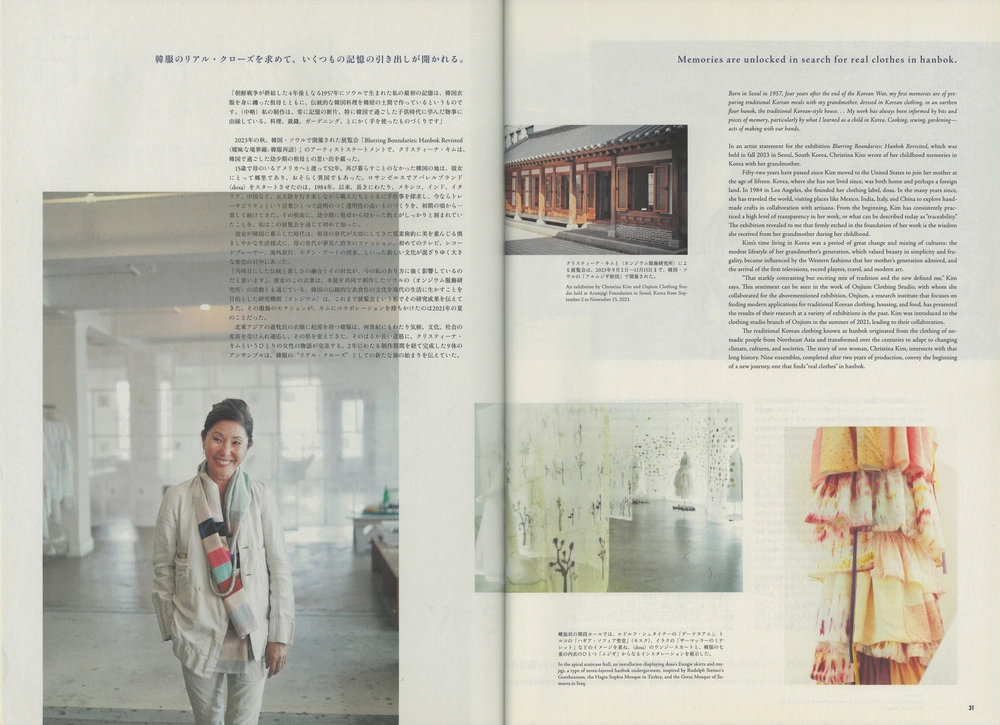
In an artist statement for the exhibition Blurring Boundaries: Hanbok Revisited, which was held in fall 2023 in Seoul, South Korea, Christina Kim wrote of her childhood memories in Korea with her grandmother.
Fifty-two years have passed since Kim moved to the United States to join her mother at the age of fifteen. Korea, where she has not lived since, was both home and perhaps a foreign land. In 1984 in Los Angeles, she founded her clothing label, dosa. In the many years since, she has traveled the world, visiting places like Mexico, India, Italy, and China to explore handmade crafts in collaboration with artisans. From the beginning, Kim has consistently practiced a high level of transparency in her work, or what can be described today as "traceability." The exhibition revealed to me that firmly etched in the foundation of her work is the wisdom she received from her grandmother during her childhood.
Kim's time living in Korea was a period of great change and mixing of cultures: the modest lifestyle of her grandmother's generation, which valued beauty in simplicity and frugality, became influenced by the Western fashions that her mother's generation admired, and the arrival of the first televisions, record players, travel, and modern art.
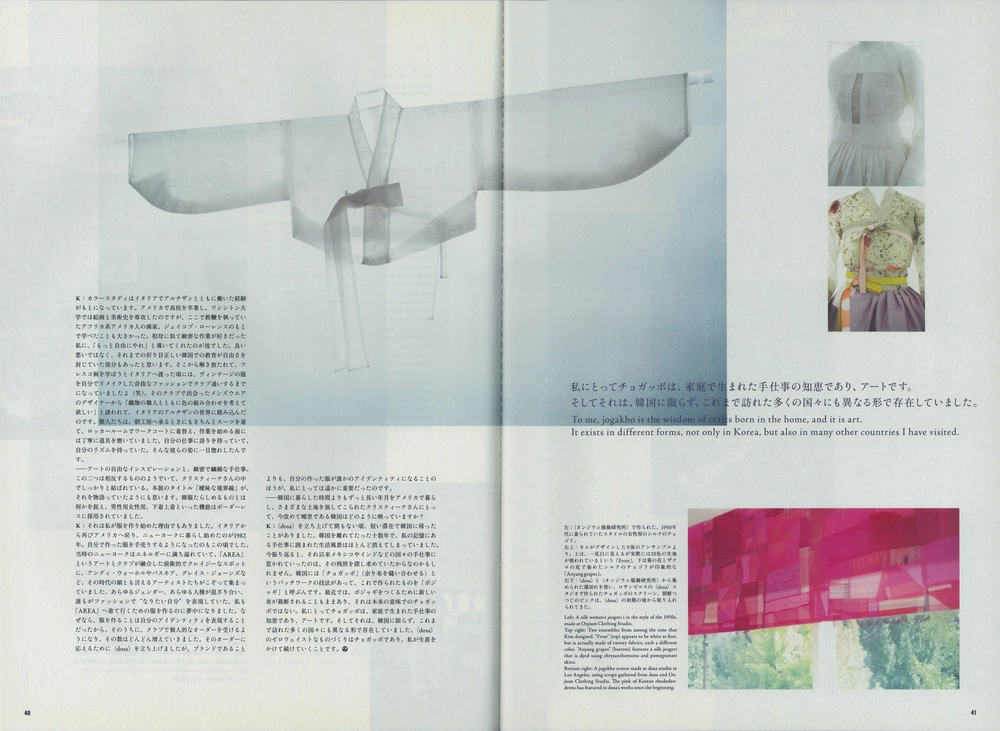
"That starkly contrasting but exciting mix of tradition and the new defined me," Kim says. This sentiment can be seen in the work of Onjium Clothing Studio, with whom she collaborated for the abovementioned exhibition. Onjium, a research institute that focuses on finding modern applications for traditional Korean clothing, housing, and food, has presented the results of their research at a variety of exhibitions in the past. Kim was introduced to the clothing studio branch of Onjium in the summer of 2021, leading to their collaboration.
The traditional Korean clothing known as hanbok originated from the clothing of nomadic people from Northeast Asia and transformed over the centuries to adapt to changing climate, cultures, and societies. The story of one woman, Christina Kim, intersects with that long history. Nine ensembles, completed after two years of production, convey the beginning of a new journey, one that finds "real clothes" in hanbok.
——The catalog for the exhibition features detailed explanations of the creative process and sources of inspiration behind each piece. These include not only your memories from your childhood in Korea, but also landscapes of the places you have traveled, and artwork and architecture that have influenced you. I was struck by the blending of countless essences drawn from your personal experiences, transcending time and borders. First, can you tell us about your grandmother, who you've written about in your artist statement?
K: When I was leaving for the US at age fifteen, I was told to pack my belongings in one small suitcase. The first thing I picked up was a pair of socks that my grandmother had mended while I was studying. My grandmother was the one who taught me how to sew. When I was a child, we lived in a traditional hanok, or Korean-style house, which wasn't particularly unusual for that time in Korea. Handcrafting still made up a large part of daily life, and like other households, my grandmother would sew things by hand, and then sort the scraps, separating large, medium, small, new and used pieces of fabric. Those scraps were then used to make other things.
——"Being simple but not shabby, splendid but not extravagant." It seems the Confucian ideal from the Joseon Dynasty, that "beauty resides in simplicity and frugality," was still prevalent in people's lives then.
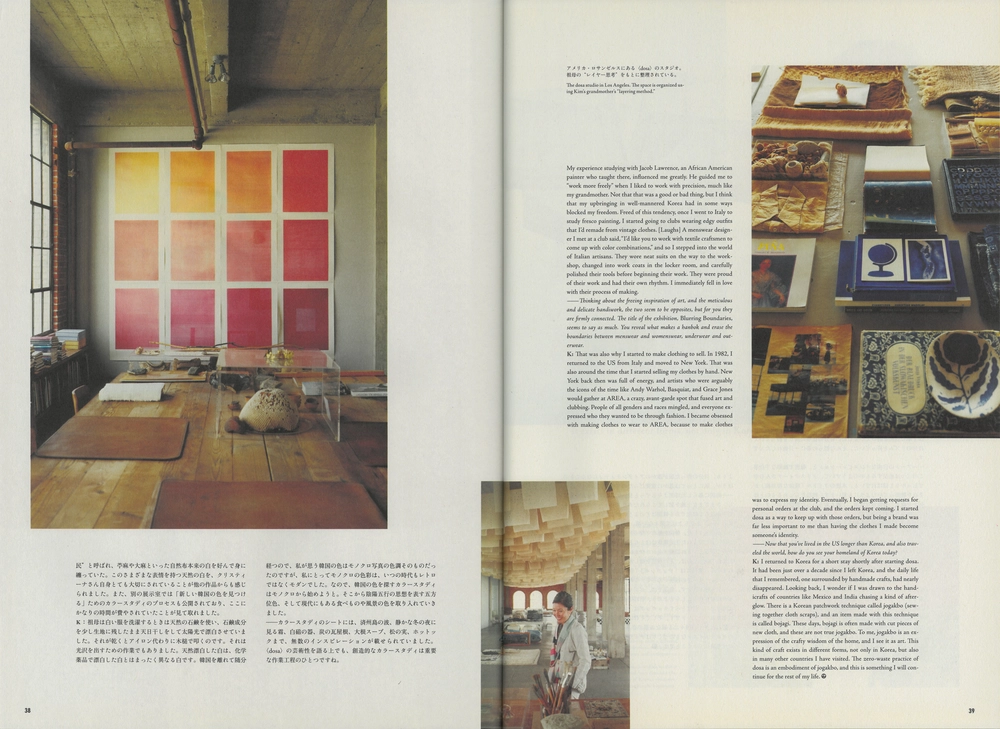
K: I think that philosophy came from a respect and love for nature. My grandmother's strong sense of beauty was based on her perspective on nature, and I was greatly influenced by her way of life. In a time when resources were scarce, my grandmother's structured method of organizing materials to limit waste was elegant, something I could see even as a child. Later on, I began incorporating this method into dosa projects and art installations, calling it "layered thinking."
——The space at dosa's Los Angeles studio is laid out like a mind map, with sources of inspiration collected from various places beautifully arranged to make them easily accessible. It's clear your commitment to zero-waste, which you've practiced since the start of dosa, was also passed down from your grandmother.
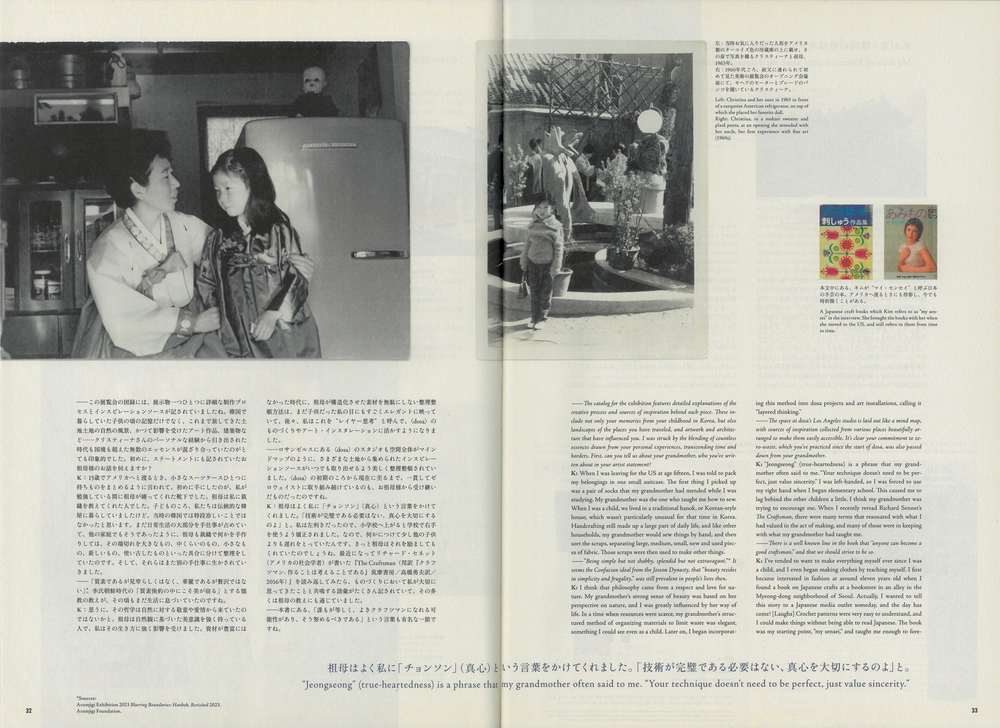
K: "Jeongseong" (true-heartedness) is a phrase that my grandmother often said to me. "Your technique doesn't need to be perfect, just value sincerity." I was left-handed, so I was forced to use my right hand when I began elementary school. This caused me to lag behind the other children a little. I think my grandmother was trying to encourage me. When I recently reread Richard Sennet's The Craftsman, there were many terms that resonated with what I had valued in the act of making, and many of those were in keeping with what my grandmother had taught me.
——There is a well known line in the book that "anyone can become a good craftsman," and that we should strive to be so.
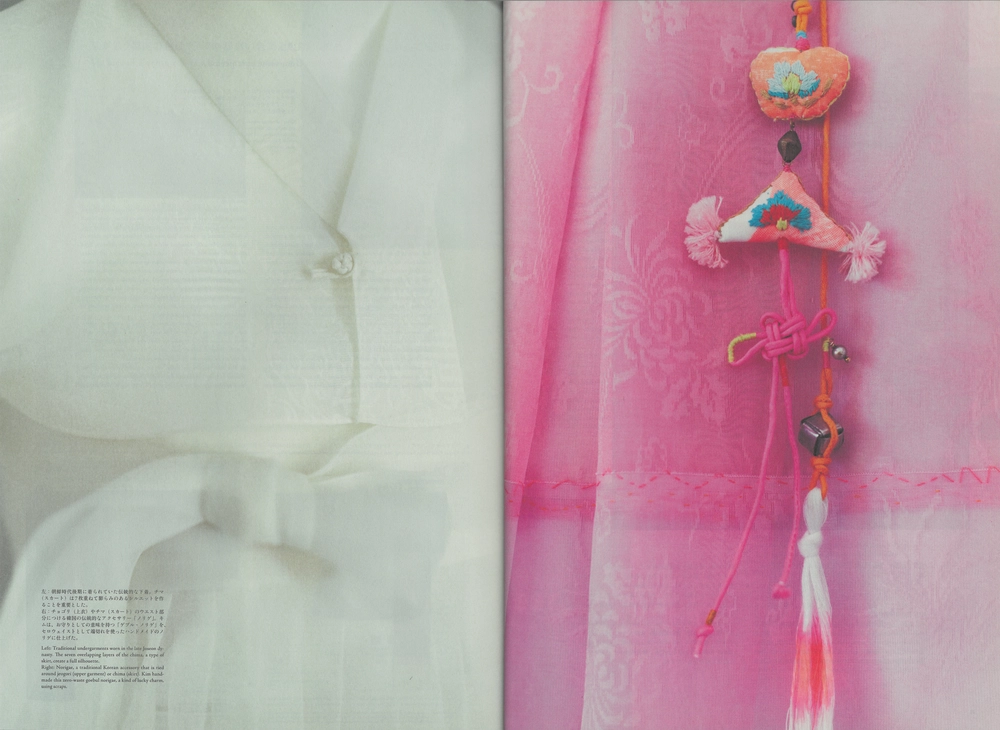
K: I've tended to want to make everything myself ever since I was a child, and I even began making clothes by teaching myself. I first became interested in fashion at around eleven years old when I found a book on Japanese crafts at a bookstore in an alley in the Myeong-dong neighborhood of Seoul. Actually, I wanted to tell this story to a Japanese media outlet someday, and the day has come! [Laughs] Crochet patterns were very easy to understand, and I could make things without being able to read Japanese. The book was my starting point, "my sensei," and taught me enough to forego fashion school. In addition, my encounter with art at the time was significant. The Korean art scene was going through a period of transformation, and my uncle and aunt, who had studied abroad and lived in Seoul, knew some of the leading modern artists and would take me to every art opening even though I was just a little kid. One exhibition I saw as a teen was by Chung Chang-sup, a part of the Dansaekhwa movement (the first Korean avant-garde painting movement known for their use of white, also known as "monochrome painting"), where I was struck by a distinctive white painting. The piece was the same warm honey color as the floor of a hanok. I was inspired by Dansaekhwa because I had been especially sensitive to color from an early age, and I was also drawn to the freedom of the idea that the color of the floor of the room where I slept could become art. This memory also inspired an ensemble in the exhibition titled Ondol (warm room).
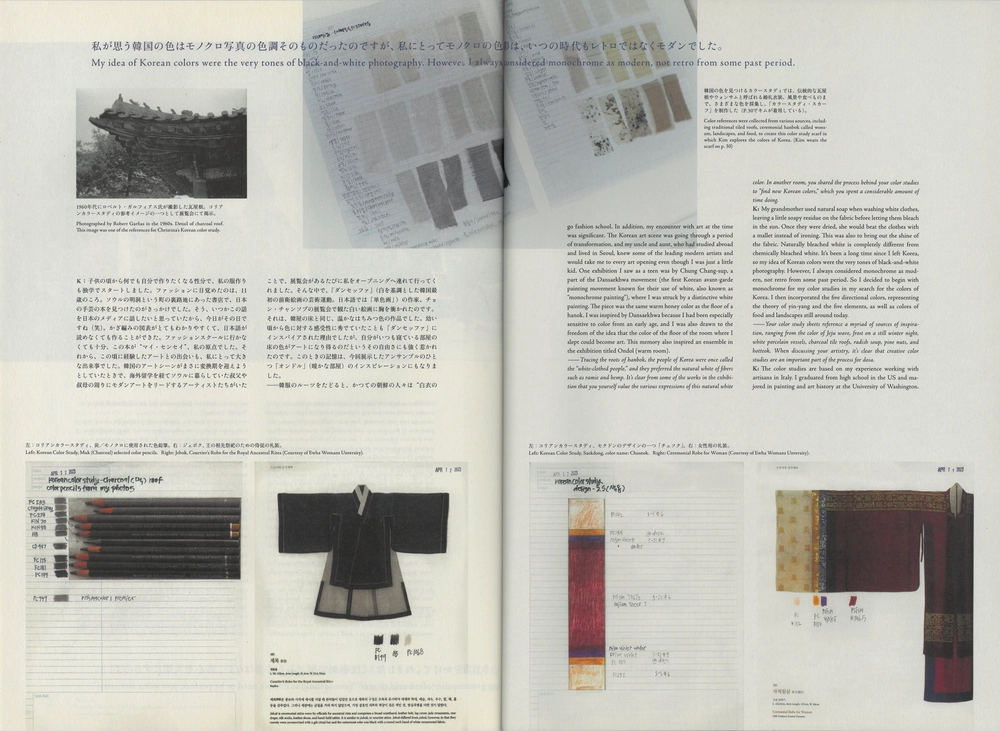
——Tracing the roots of hanbok, the people of Korea were once called the "white-clothed people," and they preferred the natural white of fibers such as ramie and hemp. It's clear from some of the works in the exhibition that you yourself value the various expressions of this natural white color. In another room, you shared the process behind your color studies to "find new Korean colors," which you spent a considerable amount of time doing.
K: My grandmother used natural soap when washing white clothes, leaving a little soapy residue on the fabric before letting them bleach in the sun. Once they were dried, she would beat the clothes with a mallet instead of ironing. This was also to bring out the shine of the fabric. Naturally bleached white is completely different from chemically bleached white. It's been a long time since I left Korea, so my idea of Korean colors were the very tones of black-and-white photography. However, I always considered monochrome as modern, not retro from some past period. So I decided to begin with monochrome for my color studies in my search for the colors of Korea. I then incorporated the five directional colors, representing the theory of yin-yang and the five elements, as well as colors of food and landscapes still around today.
——Your color study sheets reference a myriad of sources of inspiration, ranging from the color of Jeju wave, frost on a still winter night, white porcelain vessels, charcoal tile roofs, radish soup, pine nuts, and hotteok. When discussing your artistry, it's clear that creative color studies are an important part of the process for dosa.
K: The color studies are based on my experience working with artisans in Italy. I graduated from high school in the US and majored in painting and art history at the University of Washington.
My experience studying with Jacob Lawrence, an African American painter who taught there, influenced me greatly. He guided me to "work more freely" when I liked to work with precision, much like my grandmother. Not that that was a good or bad thing, but I think that my upbringing in well-mannered Korea had in some ways blocked my freedom. Freed of this tendency, once I went to Italy to study fresco painting, I started going to clubs wearing edgy outfits that I'd remade from vintage clothes. [Laughs] A menswear designer I met at a club said, "I'd like you to work with textile craftsmen to come up with color combinations," and so I stepped into the world of Italian artisans. They wore neat suits on the way to the workshop, changed into work coats in the locker room, and carefully polished their tools before beginning their work. They were proud of their work and had their own rhythm. I immediately fell in love with their process of making.
——Thinking about the freeing inspiration of art, and the meticulous and delicate handiwork, the two seem to be opposites, but for you they are firmly connected. The title of the exhibition, Blurring Boundaries, seems to say as much. You reveal what makes a hanbok and erase the boundaries between menswear and womenswear, underwear and outerwear.
K: That was also why I started to make clothing to sell. In 1982, I returned to the US from Italy and moved to New York. That was also around the time that I started selling my clothes by hand. New York back then was full of energy, and artists who were arguably the icons of the time like Andy Warhol, Basquiat, and Grace Jones would gather at AREA, a crazy, avant-garde spot that fused art and clubbing. People of all genders and races mingled, and everyone expressed who they wanted to be through fashion. I became obsessed with making clothes to wear to AREA, because to make clothes was to express my identity. Eventually, I began getting requests for personal orders at the club, and the orders kept coming. I started dosa as a way to keep up with those orders, but being a brand was far less important to me than having the clothes I made become someone's identity.
——Now that you've lived in the US longer than Korea, and also traveled the world, how do you see your homeland of Korea today?
K: I returned to Korea for a short stay shortly after starting dosa. It had been just over a decade since I left Korea, and the daily life that I remembered, one surrounded by handmade crafts, had nearly disappeared. Looking back, I wonder if I was drawn to the handicrafts of countries like Mexico and India chasing a kind of afterglow. There is a Korean patchwork technique called jogakbo (sewing together cloth scraps), and an item made with this technique is called bojagi. These days, bojagi is often made with cut pieces of new cloth, and these are not true jogakbo. To me, jogakbo is an expression of the crafty wisdom of the home, and I see it as art. This kind of craft exists in different forms, not only in Korea, but also in many other countries I have visited. The zero-waste practice of dosa is an embodiment of jogakbo, and this is something I will continue for the rest of my life.
text: Eri Ishida
photo: Mai Kise (p.31, 34 top, 36, 37, 40, 41), Keisuke Fukamizu (p.30, 38, 39), dosa (p.28, 29, pp.32-35), Ewha Womans University (p.34, 35)
coordination: Aya Muto, Choi Jieun
special thanks: Arumjigi Foundation, ONJIUM Clothing Studio, Ewha Womans University