Telegraph Magazine
Neutra Sweet
March 2, 2002
"The LA home of Christina Kim, the designer behind dosa, is a homage to the minimalist architect Richard Neutra."
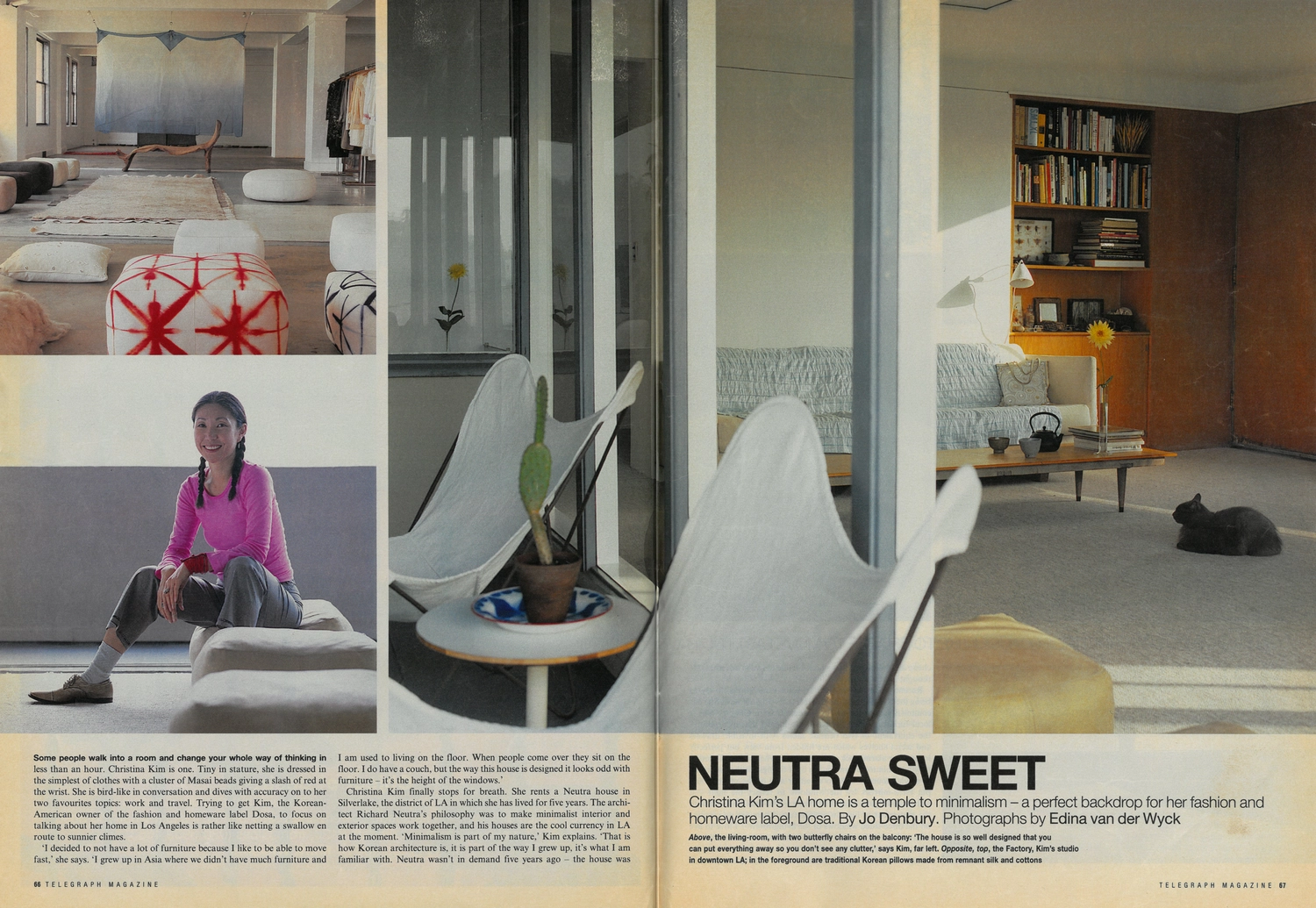
Some people walk into a room and change your whole way of thinking in less than an hour. Christina Kim is one. Tiny in stature, she is dressed in the simplest of clothes with a cluster of Masai beads giving a slash of red at the wrist. She is bird-like in conversation and dives with accuracy on to her two favourites topics: work and travel. Trying to get Kim, the Korean-American owner of the fashion and homeware label Dosa, to focus on talking about her home in Los Angeles is rather like netting a swallow en route to sunnier climes.
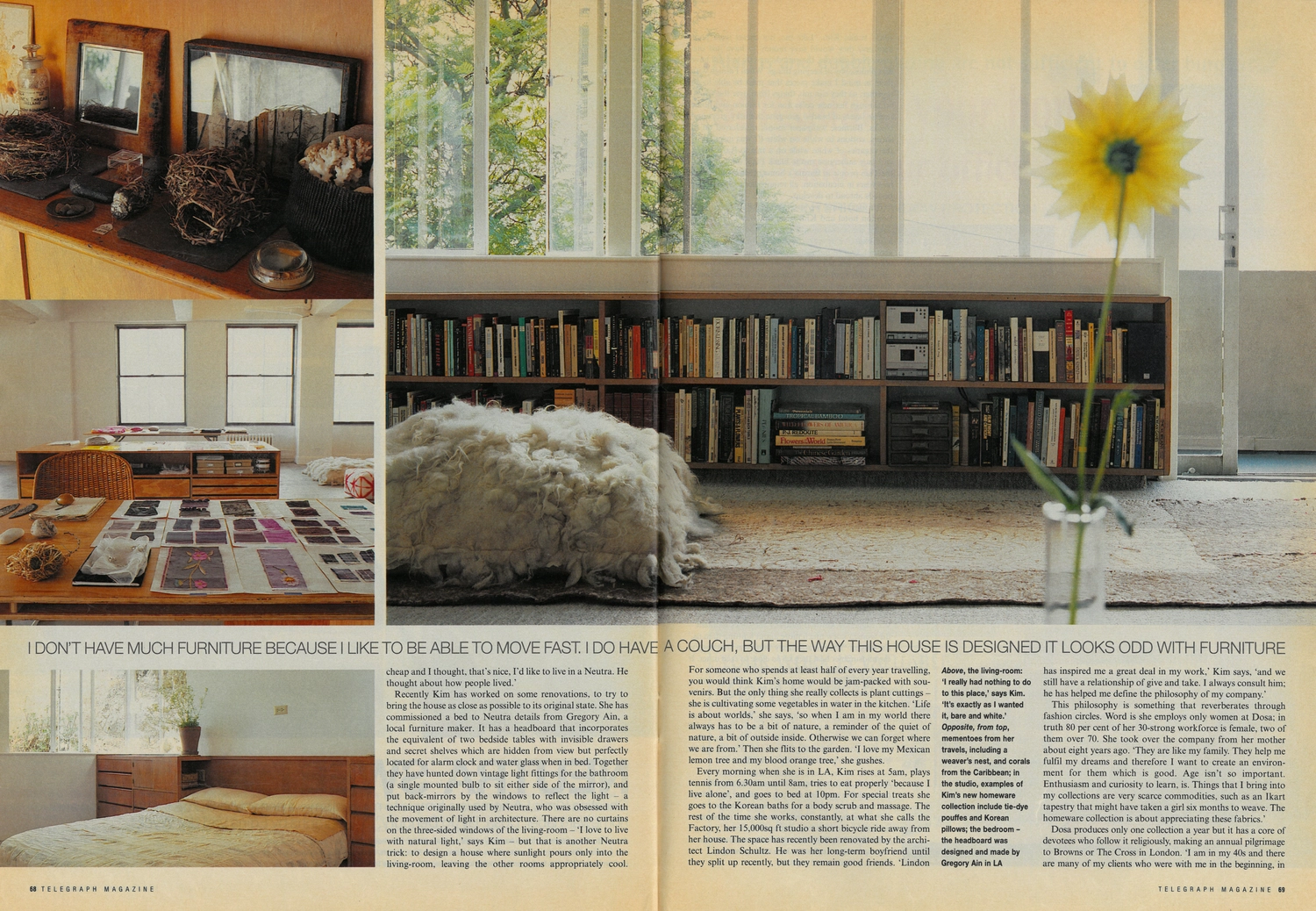
'I decided to not have a lot of furniture because I like to be able to move fast,' she says. 'I grew up in Asia where we didn't have much furniture and I am used to living on the floor. When people come over they sit on the floor. I do have a couch, but the way this house is designed it looks odd with furniture – it's the height of the windows.'
Christina Kim finally stops for breath. She rents a Neutra house in Silverlake, the district of LA in which she has lived for five years. The architect Richard Neutra's philosophy was to make minimalist interior and exterior spaces work together, and his houses are the cool currency in LA at the moment. 'Minimalism is part of my nature,' Kim explains. 'That is how Korean architecture is, it is part of the way I grew up, it's what I am familiar with. Neutra wasn't in demand five years ago – the house was cheap and I thought, that's nice, I'd like to live in a Neutra. He thought about how people lived.'
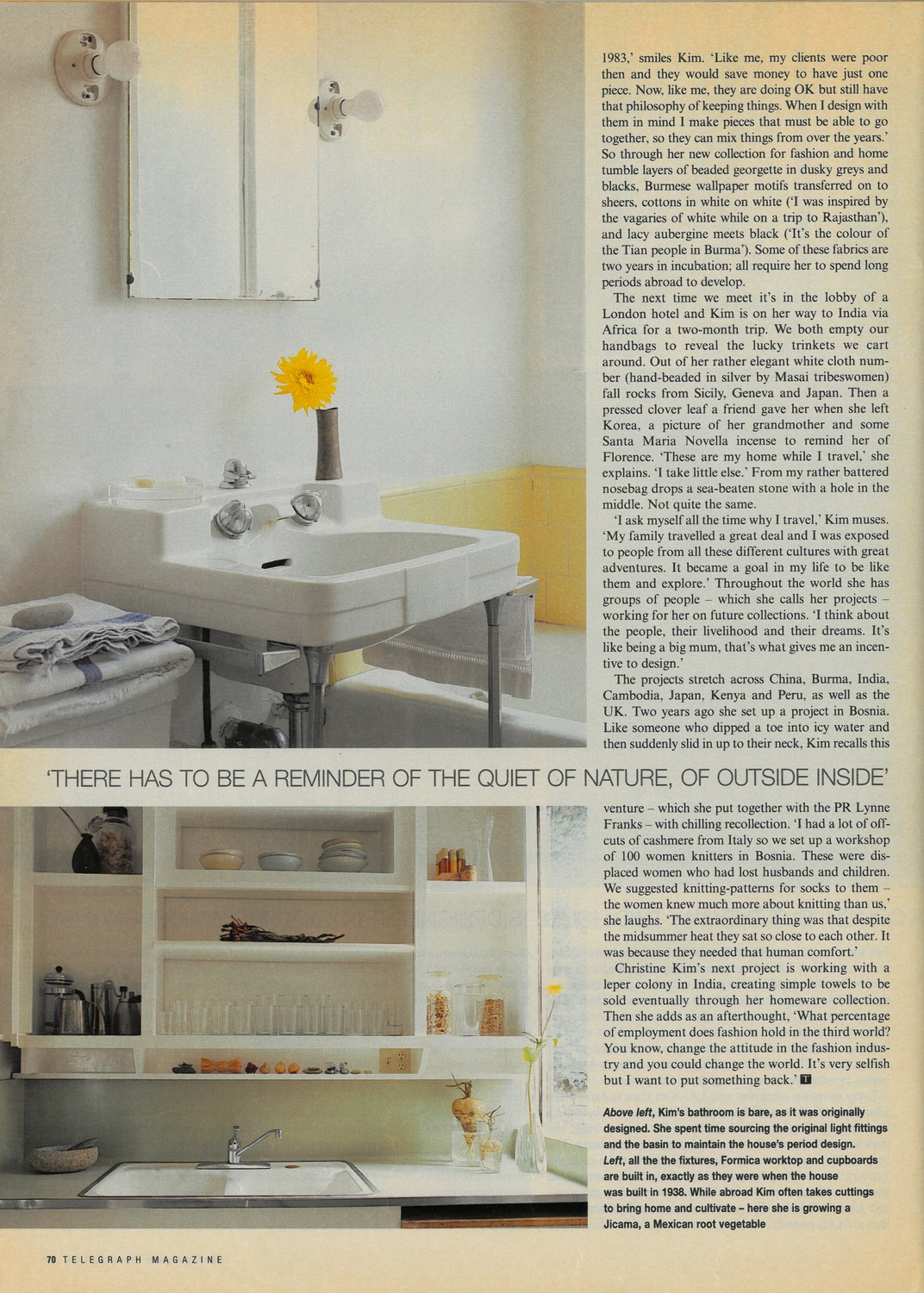
Recently Kim has worked on some renovations, to try to bring the house as close as possible to its original state. She has commissioned a bed to Neutra details from Gregory Ain, a local furniture maker. It has a headboard that incorporates the equivalent of two bedside tables with invisible drawers and secret shelves which are hidden from view but perfectly located for alarm clock and water glass when in bed. Together they have hunted down vintage light fittings for the bathroom (a single mounted bulb to sit either side of the mirror), and put back-mirrors by the windows to reflect the light – a technique originally used by Neutra, who was obsessed with the movement of light in architecture. There are no curtains on the three-sided windows of the living-room – 'I love to live with natural light,' says Kim – but that is another Neutra trick: to design a house where sunlight pours only into the living-room, leaving the other rooms appropriately cool.
For someone who spends at least half of every year travelling, you would think Kim's home would be jam-packed with souvenirs. But the only thing she really collects is plant cuttings – she is cultivating some vegetables in water in the kitchen. 'Life is about worlds,' she says, 'so when I am in my world there always has to be a bit of nature, a reminder of the quiet of nature, a bit of outside inside. Otherwise we can forget where we are from.' Then she flits to the garden. 'I love my Mexican lemon tree and my blood orange tree,' she gushes.
Every morning when she is in LA, Kim rises at 5am, plays tennis from 6.30am until 8am, tries to eat properly 'because I live alone', and goes to bed at 10pm. For special treats she goes to the Korean baths for a body scrub and massage. The rest of the time she works, constantly, at what she calls the Factory, her 15,000sq ft studio a short bicycle ride away from her house. The space has recently been renovated by the architect Lindon Schultz. He was her long-term boyfriend until they split up recently, but they remain good friends. 'Lindon has inspired me a great deal in my work,' Kim says, 'and we still have a relationship of give and take. I always consult him; he has helped me define the philosophy of my company.'
This philosophy is something that reverberates through fashion circles. Word is she employs only women at Dosa; in truth 80 per cent of her 30-strong workforce is female, two of them over 70. She took over the company from her mother about eight years ago. 'They are like my family. They help me fulfil my dreams and therefore I want to create an environment for them which is good. Age isn't so important. Enthusiasm and curiosity to learn, is. Things that I bring into my collections are very scarce commodities, such as an Ikart tapestry that might have taken a girl six months to weave. The homeware collection is about appreciating these fabrics.'
Dosa produces only one collection a year but it has a core of devotees who follow it religiously, making an annual pilgrimage to Browns or The Cross in London. 'I am in my 40s and there are many of my clients who were with me in the beginning, in 1983,' smiles Kim. 'Like me, my clients were poor then and they would save money to have just one piece. Now, like me, they are doing OK but still have that philosophy of keeping things. When I design with them in mind I make pieces that must be able to go together, so they can mix things from over the years.' So through her new collection for fashion and home tumble layers of beaded georgette in dusky greys and blacks, Burmese wallpaper motifs transferred on to sheers, cottons in white on white ('I was inspired by the vagaries of white while on a trip to Rajasthan'), and lacy aubergine meets black ('It's the colour of the Tian people in Burma'). Some of these fabrics are two years in incubation; all require her to spend long periods abroad to develop.
The next time we meet it's in the lobby of a London hotel and Kim is on her way to India via Africa for a two-month trip. We both empty our handbags to reveal the lucky trinkets we cart around. Out of her rather elegant white cloth number (hand-beaded in silver by Masai tribeswomen) fall rocks from Sicily, Geneva and Japan. Then a pressed clover leaf a friend gave her when she left Korea, a picture of her grandmother and some Santa Maria Novella incense to remind her of Florence. 'These are my home while I travel,' she explains. 'I take little else.' From my rather battered nosebag drops a sea-beaten stone with a hole in the middle. Not quite the same.
'I ask myself all the time why I travel,' Kim muses. 'My family travelled a great deal and I was exposed to people from all these different cultures with great adventures. It became a goal in my life to be like them and explore.' Throughout the world she has groups of people – which she calls her projects – working for her on future collections. 'I think about the people, their livelihood and their dreams. It's like being a big mum, that's what gives me an incentive to design.'
The projects stretch across China, Burma, India, Cambodia, Japan, Kenya and Peru, as well as the UK. Two years ago she set up a project in Bosnia. Like someone who dipped a toe into icy water and then suddenly slid in up to their neck, Kim recalls this venture – which she put together with the PR Lynne Franks – with chilling recollection. 'I had a lot of off-cuts of cashmere from Italy so we set up a workshop of 100 women knitters in Bosnia. These were displaced women who had lost husbands and children. We suggested knitting-patterns for socks to them – the women knew much more about knitting than us,' she laughs. 'The extraordinary thing was that despite the midsummer heat they sat so close to each other. It was because they needed that human comfort.'
Christine Kim's next project is working with a leper colony in India, creating simple towels to be sold eventually through her homeware collection. Then she adds as an afterthought, 'What percentage of employment does fashion hold in the third world? You know, change the attitude in the fashion industry and you could change the world. It's very selfish but I want to put something back.'
text: Jo Denbury
photo: Edina van der Wyck