The Plant magazine
Materialising Observation, Gratitude & Joy
June 2024
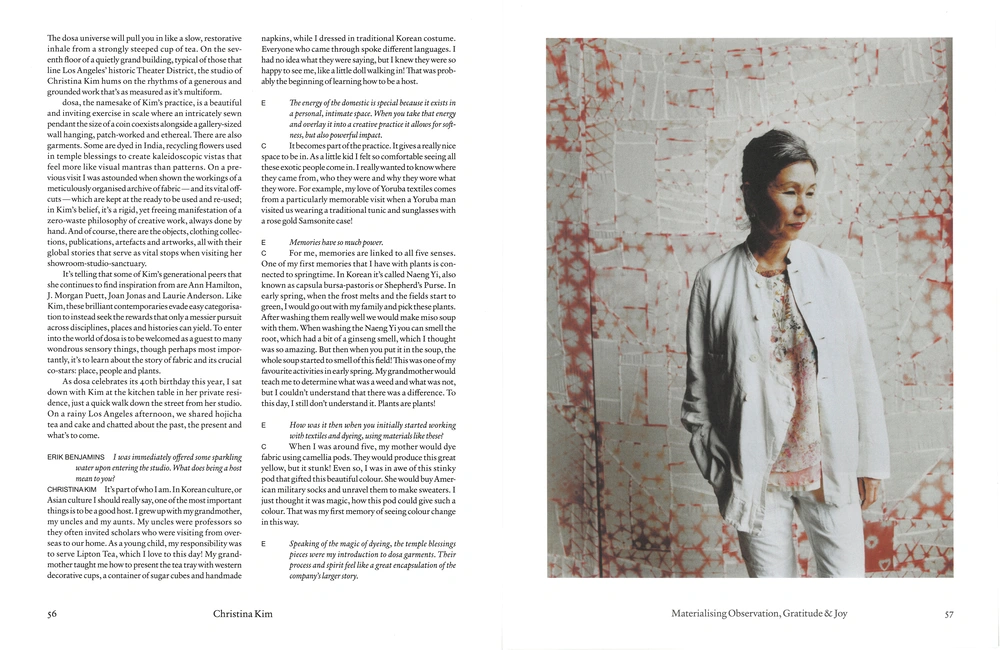
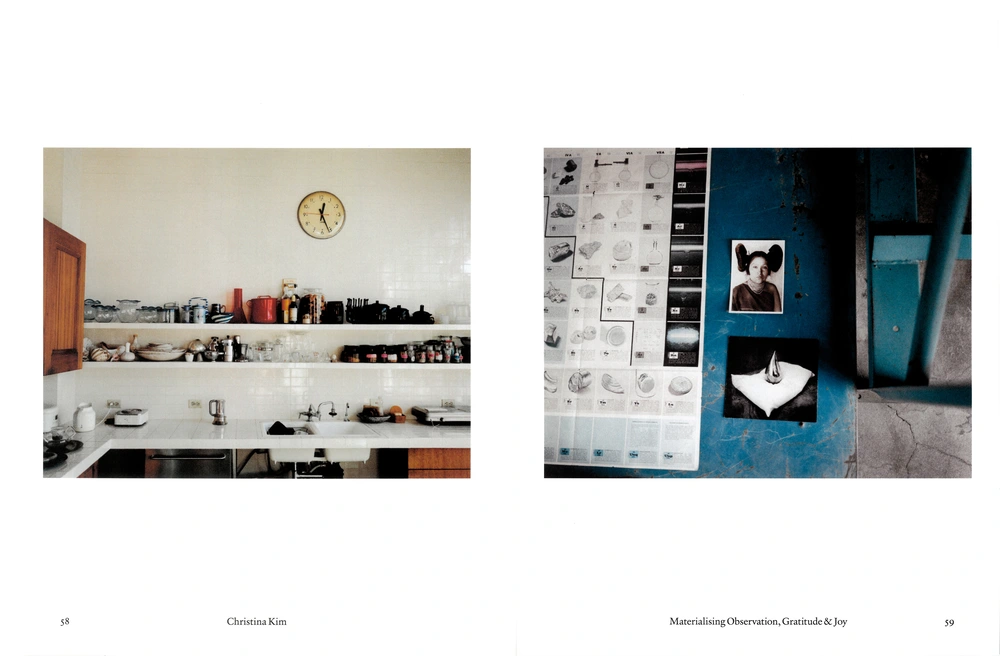
The dosa universe will pull you in like a slow, restorative inhale from a strongly steeped cup of tea. On the seventh floor of a quietly grand building, typical of those that line Los Angeles' historic Theater District, the studio of Christina Kim hums on the rhythms of a generous and grounded work that's as measured as it's multiform.
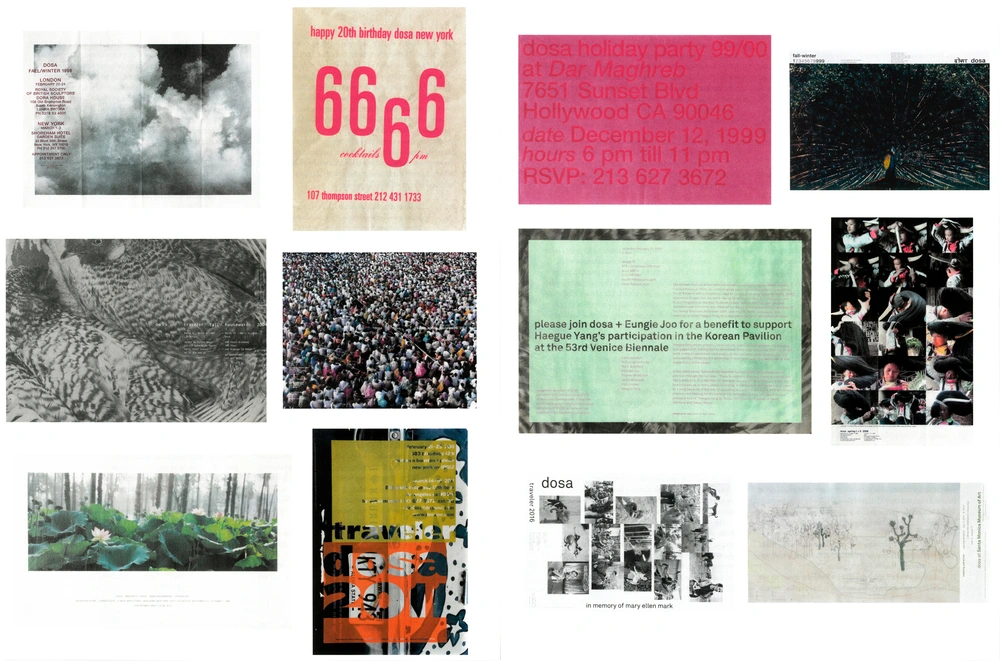
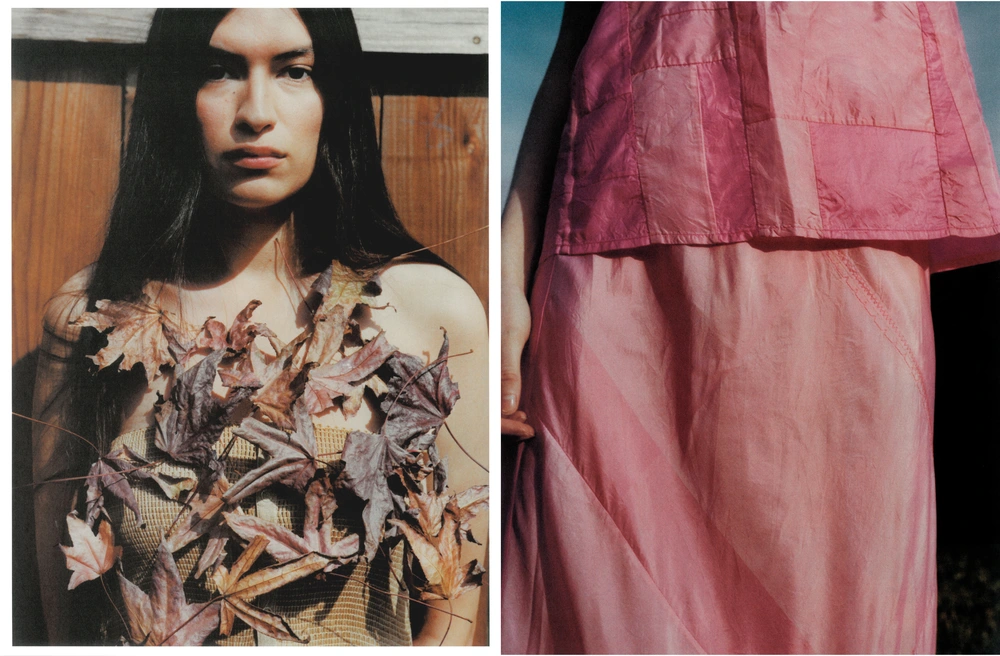
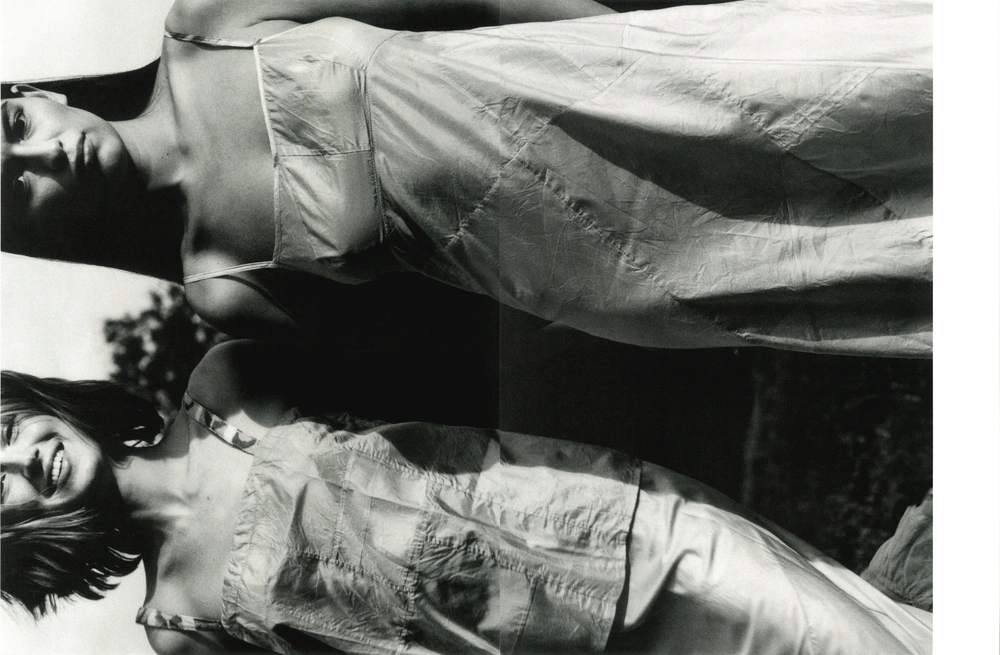
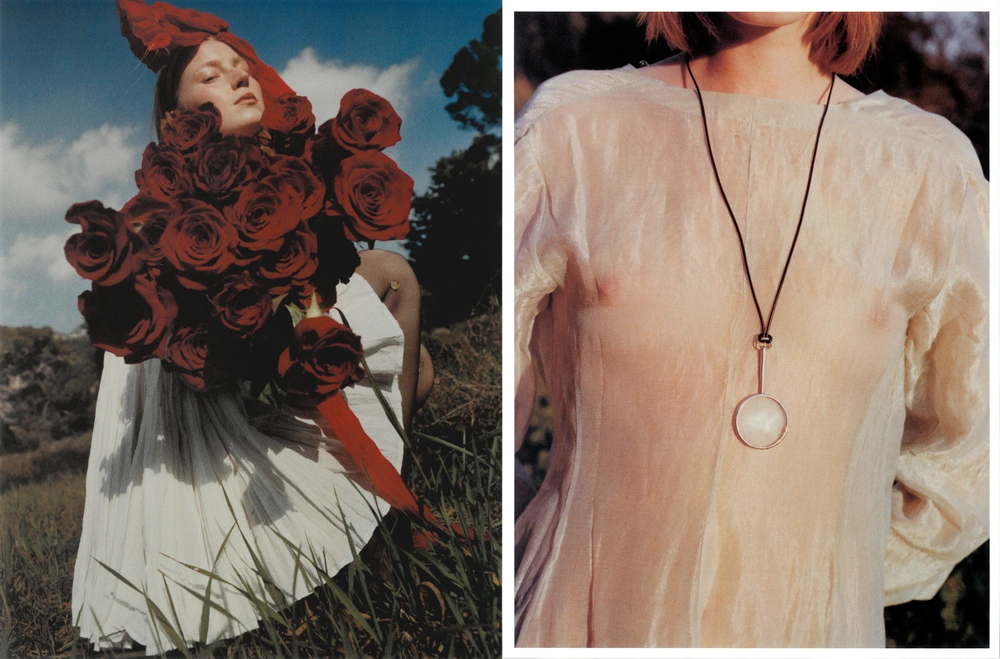
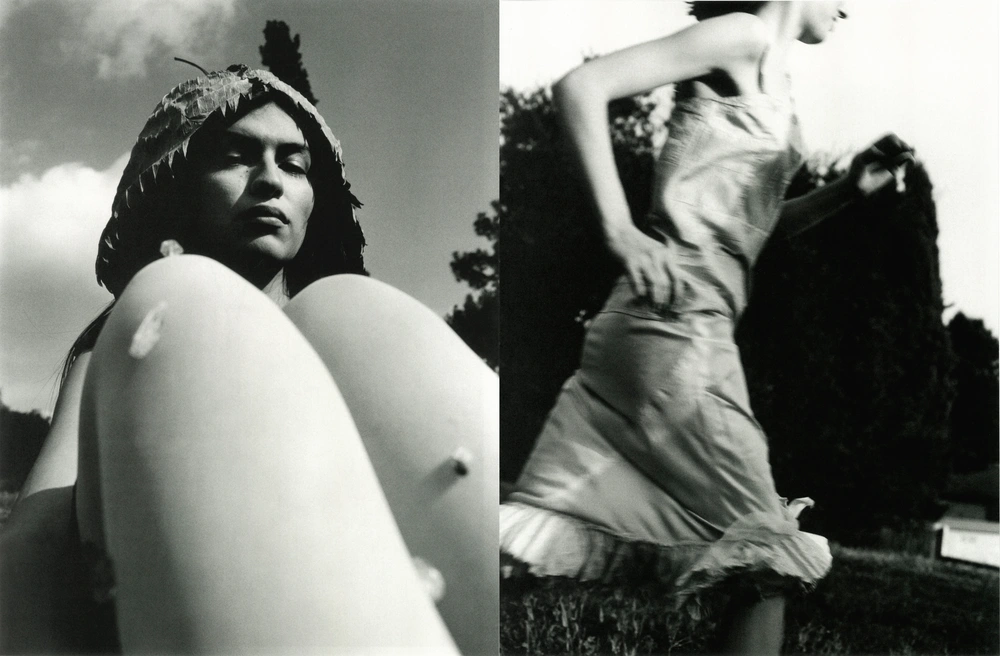
dosa, the namesake of Kim's practice, is a beautiful and inviting exercise in scale where an intricately sewn pendant the size of a coin coexists alongside a gallery-sized wall hanging, patch-worked and ethereal. There are also garments. Some are dyed in India, recycling flowers used in temple blessings to create kaleidoscopic vistas that feel more like visual mantras than patterns. On a previous visit I was astounded when shown the workings of a meticulously organised archive of fabric—and its vital offcuts—which are kept at the ready to be used and re-used; in Kim's belief, it's a rigid, yet freeing manifestation of a zero-waste philosophy of creative work, always done by hand. And of course, there are the objects, clothing collections, publications, artefacts and artworks, all with their global stories that serve as vital stops when visiting her showroom-studio-sanctuary.
It's telling that some of Kim's generational peers that she continues to find inspiration from are Ann Hamilton, J. Morgan Puett, Joan Jonas and Laurie Anderson. Like Kim, these brilliant contemporaries evade easy categorisation to instead seek the rewards that only a messier pursuit across disciplines, places and histories can yield. To enter into the world of dosa is to be welcomed as a guest to many wondrous sensory things, though perhaps most importantly, it's to learn about the story of fabric and its crucial co-stars: place, people and plants.
As dosa celebrates its 40th birthday this year, I sat down with Kim at the kitchen table in her private residence, just a quick walk down the street from her studio. On a rainy Los Angeles afternoon, we shared hojicha tea and cake and chatted about the past, the present and what's to come.
ERIK BENJAMINS I was immediately offered some sparkling water upon entering the studio. What does being a host mean to you?
CHRISTINA KIM It's part of who I am. In Korean culture, or Asian culture I should really say, one of the most important things is to be a good host. I grew up with my grandmother, my uncles and my aunts. My uncles were professors so they often invited scholars who were visiting from overseas to our home. As a young child, my responsibility was to serve Lipton Tea, which I love to this day! My grandmother taught me how to present the tea tray with western decorative cups, a container of sugar cubes and handmade napkins, while I dressed in traditional Korean costume. Everyone who came through spoke different languages. I had no idea what they were saying, but I knew they were so happy to see me, like a little doll walking in! That was probably the beginning of learning how to be a host.
E The energy of the domestic is special because it exists in a personal, intimate space. When you take that energy and overlay it into a creative practice it allows for softness, but also powerful impact.
C It becomes part of the practice. It gives a really nice space to be in. As a little kid I felt so comfortable seeing all these exotic people come in. I really wanted to know where they came from, who they were and why they wore what they wore. For example, my love of Yoruba textiles comes from a particularly memorable visit when a Yoruba man visited us wearing a traditional tunic and sunglasses with a rose gold Samsonite case!
E Memories have so much power.
C For me, memories are linked to all five senses. One of my first memories that I have with plants is connected to springtime. In Korean it's called Naeng Yi, also known as capsula bursa-pastoris or Shepherd's Purse. In early spring, when the frost melts and the fields start to green, I would go out with my family and pick these plants. After washing them really well we would make miso soup with them. When washing the Naeng Yi you can smell the root, which had a bit of a ginseng smell, which I thought was so amazing. But then when you put it in the soup, the whole soup started to smell of this field! This was one of my favourite activities in early spring. My grandmother would teach me to determine what was a weed and what was not, but I couldn't understand that there was a difference. To this day, I still don't understand it. Plants are plants!
E How was it then when you initially started working with textiles and dyeing, using materials like these?
C When I was around five, my mother would dye fabric using camellia pods. They would produce this great yellow, but it stunk! Even so, I was in awe of this stinky pod that gifted this beautiful colour. She would buy American military socks and unravel them to make sweaters. I just thought it was magic, how this pod could give such a colour. That was my first memory of seeing colour change in this way.
E Speaking of the magic of dyeing, the temple blessings pieces were my introduction to dosa garments. Their process and spirit feel like a great encapsulation of the company's larger story.
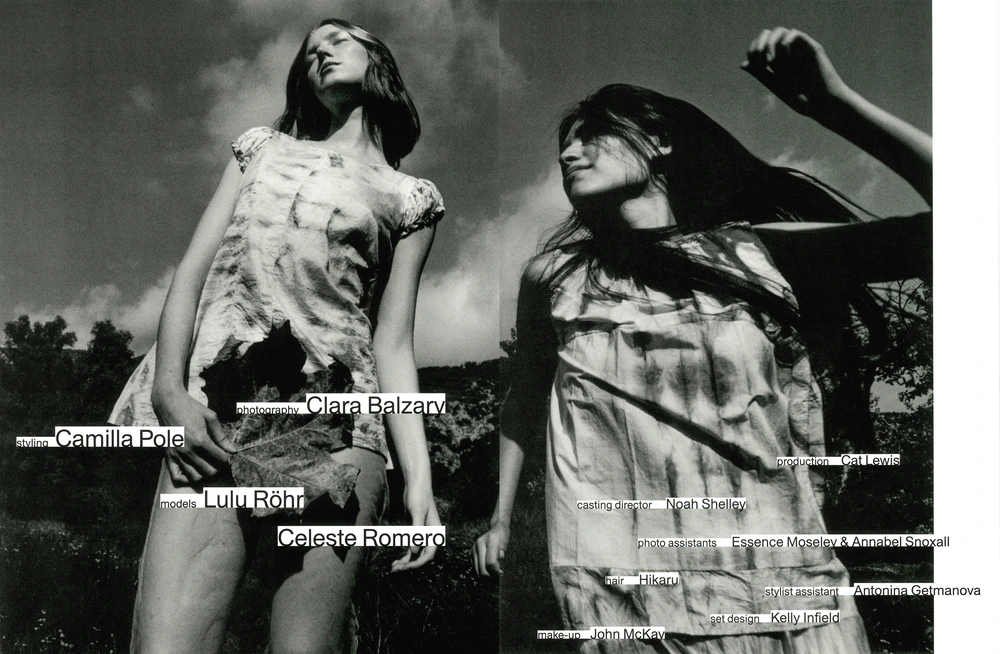
C What I really love about that temple blessings project is that it's coming out of an Indian tradition where flowers are used as a presentation of devotion. Like everything else, life ends. We're taking flowers like marigolds that are used for blessings right before the end of their life cycle to make an imprint onto fabric. This allows their life to continue. After the dyeing process, the materials return to the traditional Hindu cycle, which is back to the water and then to become part of the earth. With this dyeing we're just stretching a little bit of that process. And then you get to wear it. I also think it's interesting that these flowers, vegetables and fruits are blessed by Hindu priests, which means that in a way, the wearer receives that devotion and energy within the garment.
E Thinking about the durational, I love that way of you phrasing it. You're just stretching that last moment of a natural material's life and imprinting it onto something intended to be worn.
C We should really talk about the fabric too. I've watched artisans in Mexico start from growing cottons and hand-picking to hand-ginning. I've seen the whole process of a plant becoming a fabric. In places like Mexico, China and India, most of these people are not recognised. Most of these people make very little money. What I could do in return, out of gratitude, is use as much of the material as possible. It's a maximalist way to honour their effort. The system has made it so I can only pay so much money to them. Because I'm not able to pay them more, what I can do is I could honour their time and skill by using as much as possible. So zero waste really comes from observing weavers, spinners and ginners. People who have to spend time making the fibre—and growing, which is a really difficult job! I think that's where my heart is. I think the best thing I could do, in terms of offering gratitude, is use it all up.
E "Maximalism" is such an effective way to describe this spirit of working "in response". Formally speaking, your work across artworks and garments can be nuanced, graceful and minimalist, there is still this maximalist gesture that reflects a sense of gratitude through observation.
C The only reason I realised it is because I went to so many places to see how things are done. Once while working with the Miao in China, who are known for their indigo, I observed from beginning to the end the processes they used to create their fabric. And you know what? They and many others that do this work do it with joy. I've always preferred to work in community, village-based settings rather than industrial factories and what I continually observe is that there's quite a bit of joy in making. It's wonderful to honour that.
E That joy is inherent to me. I feel it in the DNA of dosa. I'm also enjoying thinking about your practice as one that collapses binaries. Things like minimalism and maximalism, the functional with the poetic, the old and the new.
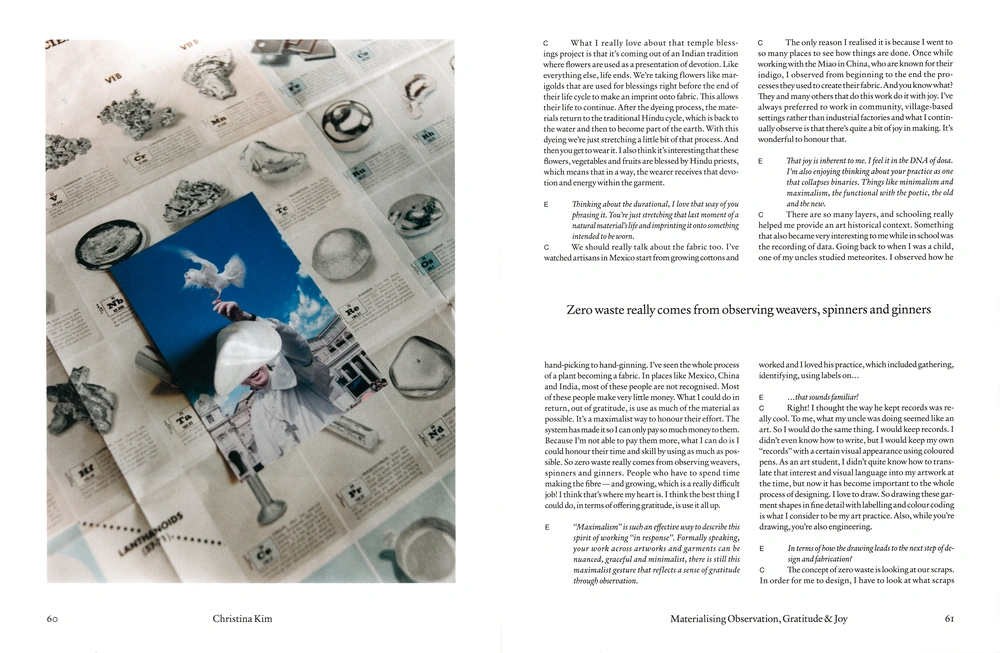
C There are so many layers, and schooling really helped me provide an art historical context. Something that also became very interesting to me while in school was the recording of data. Going back to when I was a child, one of my uncles studied meteorites. I observed how he worked and I loved his practice, which included gathering, identifying, using labels on…
E …that sounds familiar!
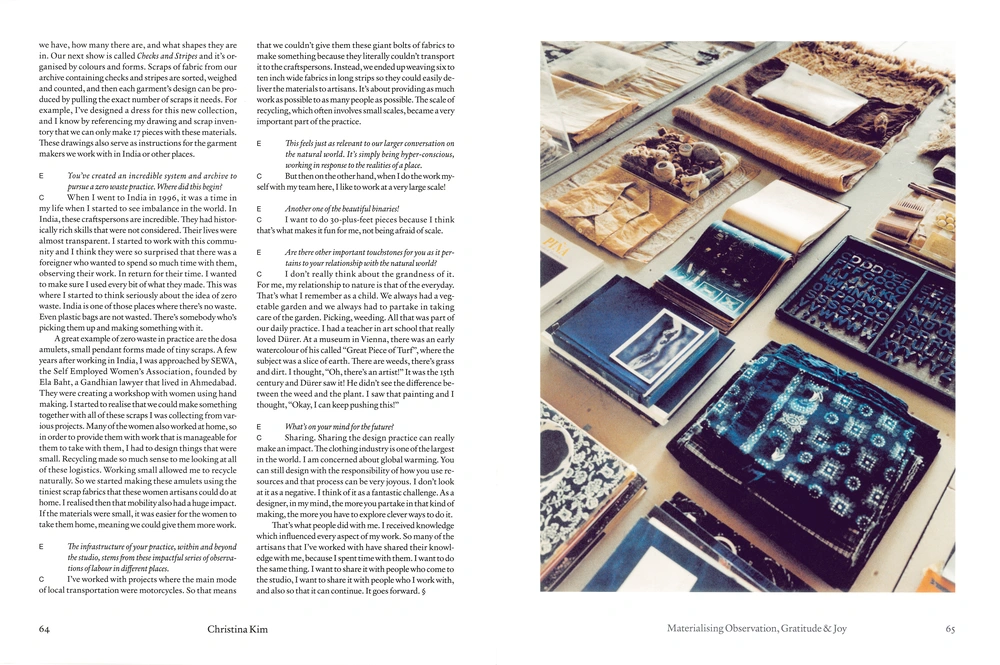
C Right! I thought the way he kept records was really cool. To me, what my uncle was doing seemed like an art. So I would do the same thing. I would keep records. I didn't even know how to write, but I would keep my own "records" with a certain visual appearance using coloured pens. As an art student, I didn't quite know how to translate that interest and visual language into my artwork at the time, but now it has become important to the whole process of designing. I love to draw. So drawing these garment shapes in fine detail with labelling and colour coding is what I consider to be my art practice. Also, while you're drawing, you're also engineering.
E In terms of how the drawing leads to the next step of design and fabrication?
C The concept of zero waste is looking at our scraps. In order for me to design, I have to look at what scraps we have, how many there are, and what shapes they are in. Our next show is called Checks and Stripes and it's organised by colours and forms. Scraps of fabric from our archive containing checks and stripes are sorted, weighed and counted, and then each garment's design can be produced by pulling the exact number of scraps it needs. For example, I've designed a dress for this new collection, and I know by referencing my drawing and scrap inventory that we can only make 17 pieces with these materials. These drawings also serve as instructions for the garment makers we work with in India or other places.
E You've created an incredible system and archive to pursue a zero waste practice. Where did this begin?
C When I went to India in 1996, it was a time in my life when I started to see imbalance in the world. In India, these craftspersons are incredible. They had historically rich skills that were not considered. Their lives were almost transparent. I started to work with this community and I think they were so surprised that there was a foreigner who wanted to spend so much time with them, observing their work. In return for their time, I wanted to make sure I used every bit of what they made. This was where I started to think seriously about the idea of zero waste. India is one of those places where there's no waste. Even plastic bags are not wasted. There's somebody who's picking them up and making something with it.
A great example of zero waste in practice are the dosa amulets, small pendant forms made of tiny scraps. A few years after working in India, I was approached by SEWA, the Self Employed Women's Association, founded by Ela Baht, a Gandhian lawyer that lived in Ahmedabad. They were creating a workshop with women using hand making. I started to realise that we could make something together with all of these scraps I was collecting from various projects. Many of the women also worked at home, so in order to provide them with work that is manageable for them to take with them, I had to design things that were small. Recycling made so much sense to me looking at all of these logistics. Working small allowed me to recycle naturally. So we started making these amulets using the tiniest scrap fabrics that these women artisans could do at home. I realised then that mobility also had a huge impact. If the materials were small, it was easier for the women to take them home, meaning we could give them more work.
E The infrastructure of your practice, within and beyond the studio, stems from these impactful series of observations of labour in different places.
C I've worked with projects where the main mode of local transportation were motorcycles. So that means that we couldn't give them these giant bolts of fabrics to make something because they literally couldn't transport it to the craftspersons. Instead, we ended up weaving six to ten inch wide fabrics in long strips so they could easily deliver the materials to artisans. It's about providing as much work as possible to as many people as possible. The scale of recycling, which often involves small scales, became a very important part of the practice.
E This feels just as relevant to our larger conversation on the natural world. It's simply being hyper-conscious, working in response to the realities of a place.
C But then on the other hand, when I do the work myself with my team here, I like to work at a very large scale!
E Another one of the beautiful binaries!
C I want to do 30-plus-feet pieces because I think that's what makes it fun for me, not being afraid of scale.
E Are there other important touchstones for you as it pertains to your relationship with the natural world?
C I don't really think about the grandness of it. For me, my relationship to nature is that of the everyday. That's what I remember as a child. We always had a vegetable garden and we always had to partake in taking care of the garden. Picking, weeding. All that was part of our daily practice. I had a teacher in art school that really loved Dürer. At a museum in Vienna, there was an early watercolour of his called "Great Piece of Turf", where the subject was a slice of earth. There are weeds, there's grass and dirt. I thought, "Oh, there's an artist!" It was the 15th century and Dürer saw it! He didn't see the difference between the weed and the plant. I saw that painting and I thought, "Okay, I can keep pushing this!"
E What's on your mind for the future?
C Sharing. Sharing the design practice can really make an impact. The clothing industry is one of the largest in the world. I am concerned about global warming. You can still design with the responsibility of how you use resources and that process can be very joyous. I don't look at it as a negative. I think of it as a fantastic challenge. As a designer, in my mind, the more you partake in that kind of making, the more you have to explore clever ways to do it.
That's what people did with me. I received knowledge which influenced every aspect of my work. So many of the artisans that I've worked with have shared their knowledge with me, because I spent time with them. I want to do the same thing. I want to share it with people who come to the studio, I want to share it with people who I work with, and also so that it can continue. It goes forward.
text: Erik Benjamins
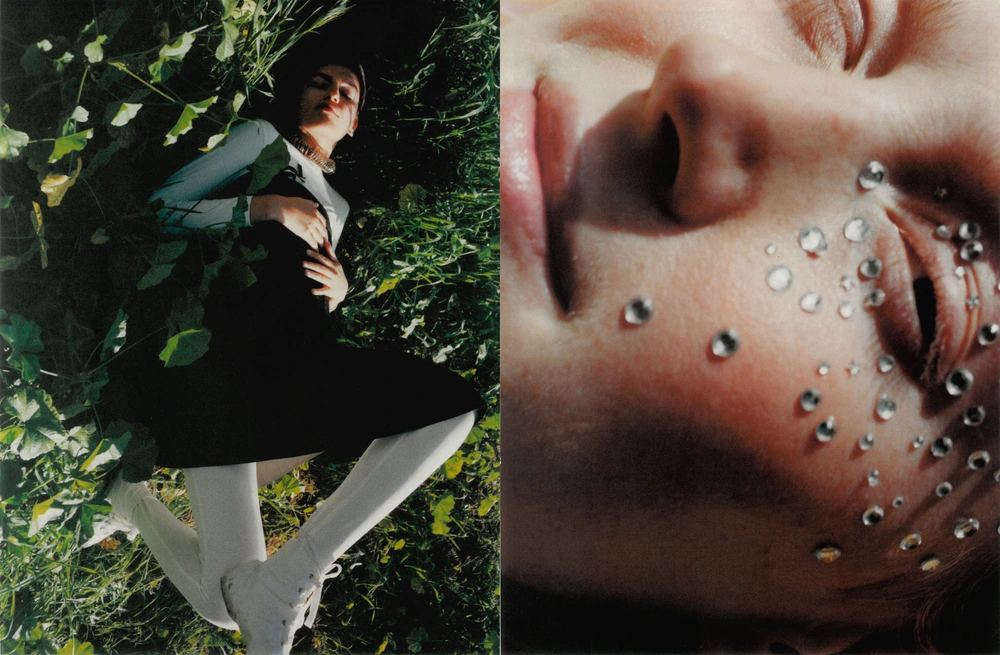
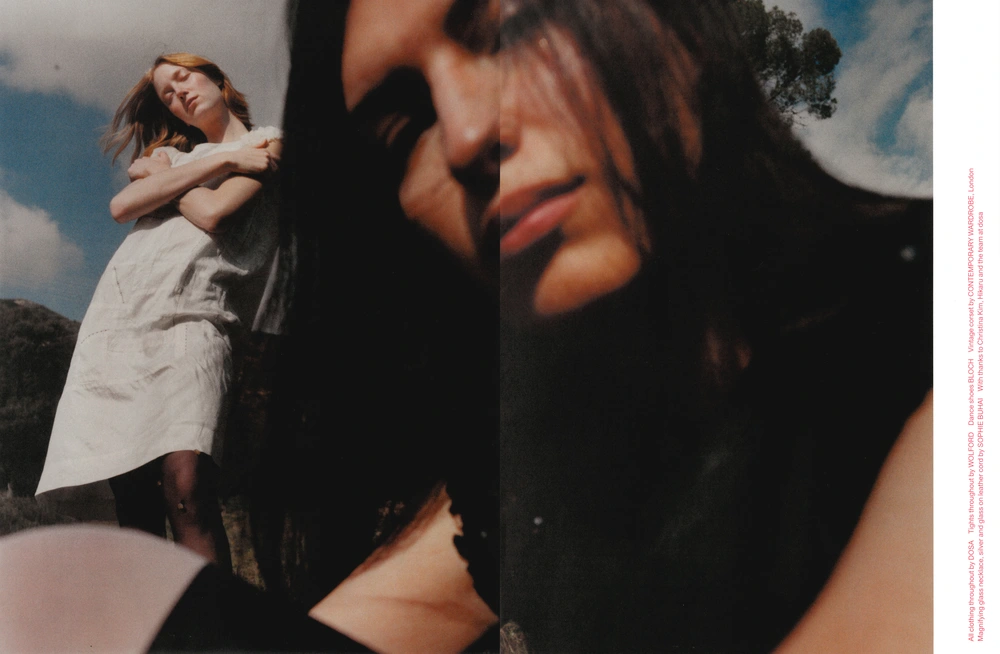
photo: Jack Bool, Clara Balzary
stylist: Camilla Pole
models: Lulu Rohr, Celeste Romero