Vogue British
safari luxe
February 2002
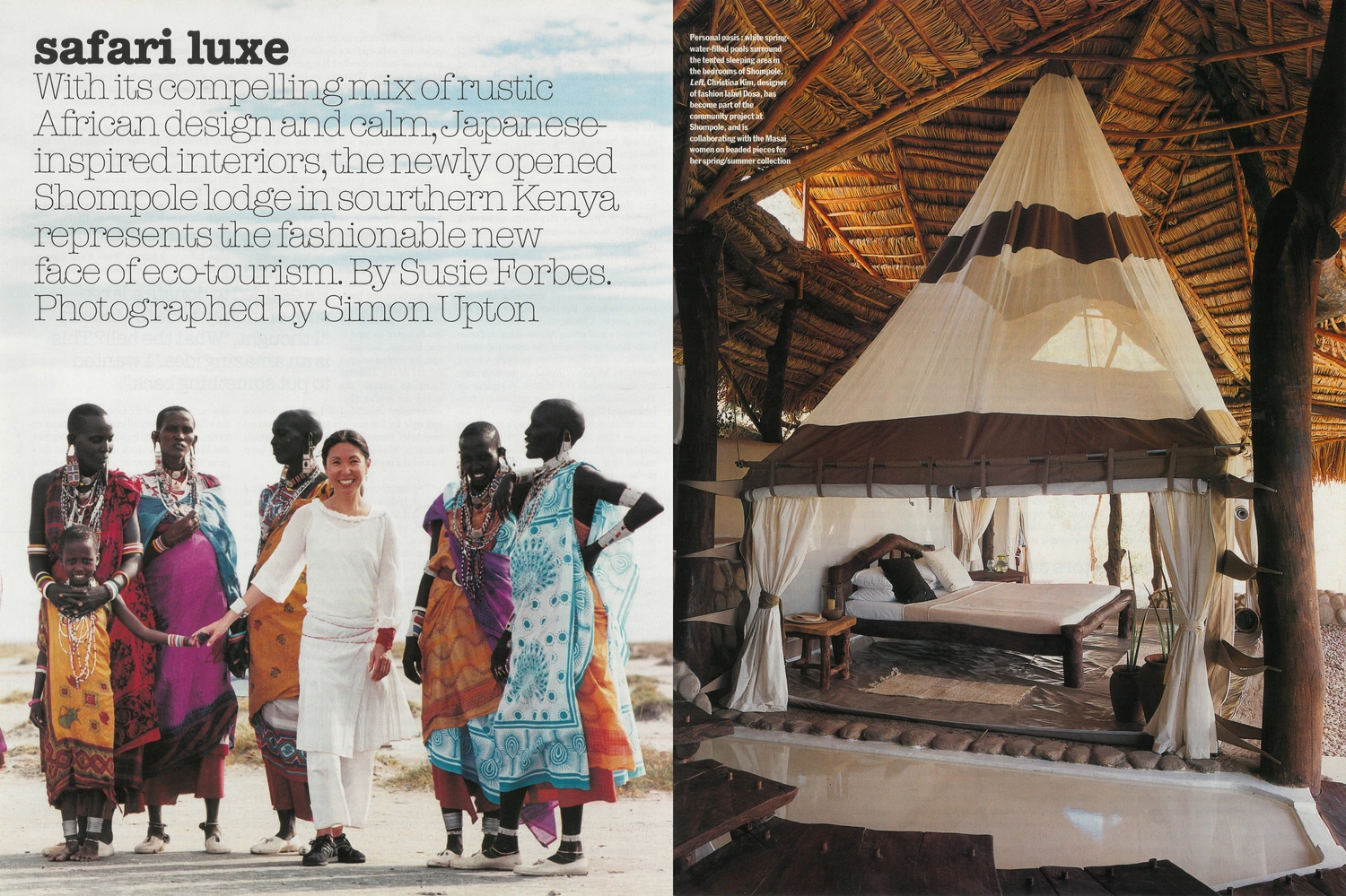
"With its compelling mix of rustic African design and calm, Japanese inspired interiors, the newly opened Shompole lodge in sourthern Kenya represents the fashionable new face of eco tourism."
Standing in the arrivals hall at Nairobi airport, Elizabeth Warner, dressed head-to-toe in layers of flowing white linen, looks exactly like she just walked out of one of those Out of Africa or The Sheltering Sky-type movies. And if she is pure romantic heroine, her boyfriend Anthony Russell, a shaggier version of Richard Gere, looks every bit the dashing white hunter. In reality, however, Russell is an ardent conservationist and the driving force behind both Art of Journeys, a bespoke safari company, and the newly opened Shompole Camp and game reserve in southern Kenya.
The latter is a truly extraordinary place. A short hop by plane from Nairobi, this is a part of Kenya previously untapped by tourists, and staggering in its diversity. Within a relatively small area, visitors can see everything from flamingo-covered soda lakes to glistening white salt pans, thick forest, papyrus swamp, mountains and the acacia-strewn grassland that is home to most of the native wildlife.
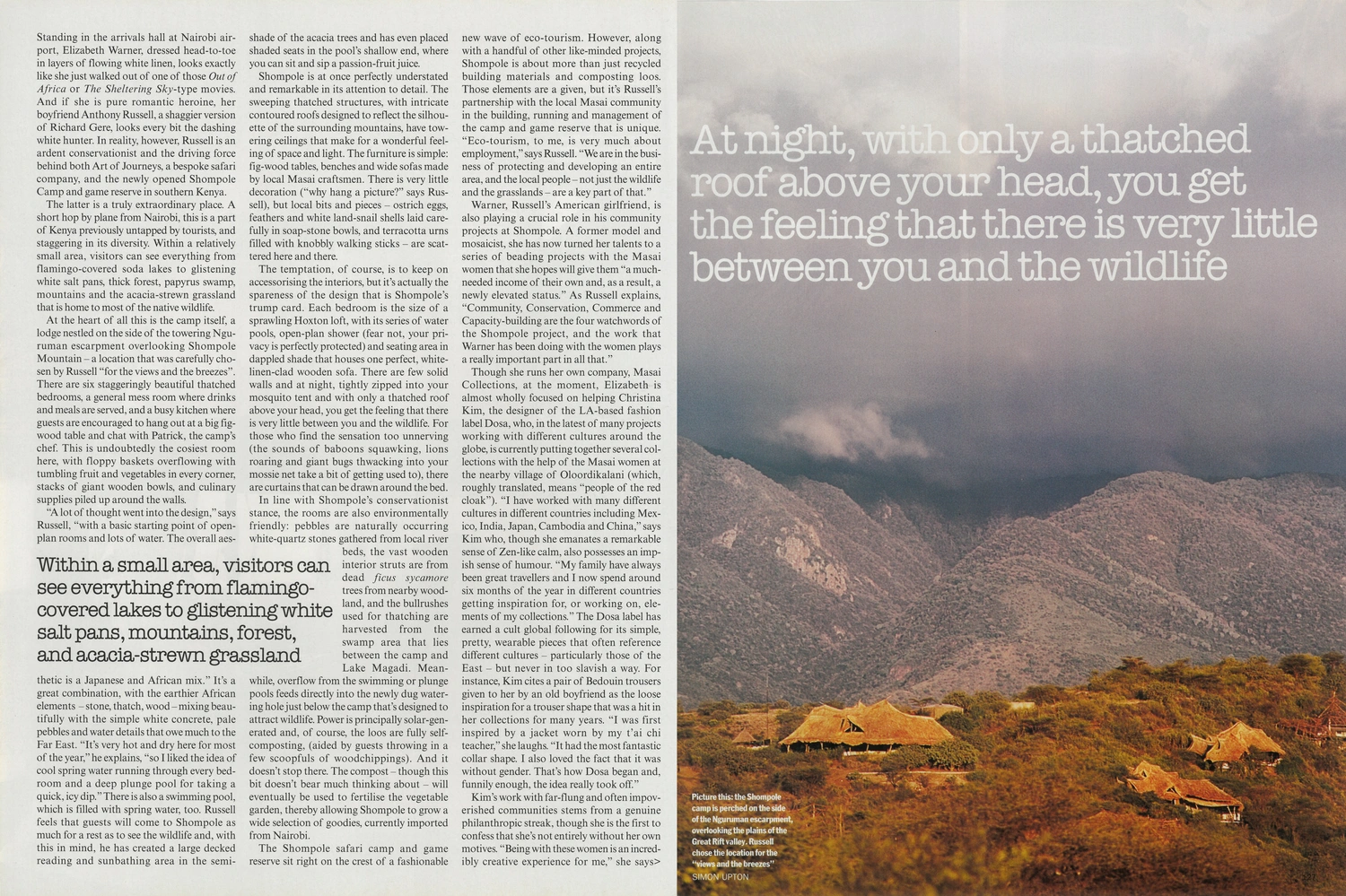
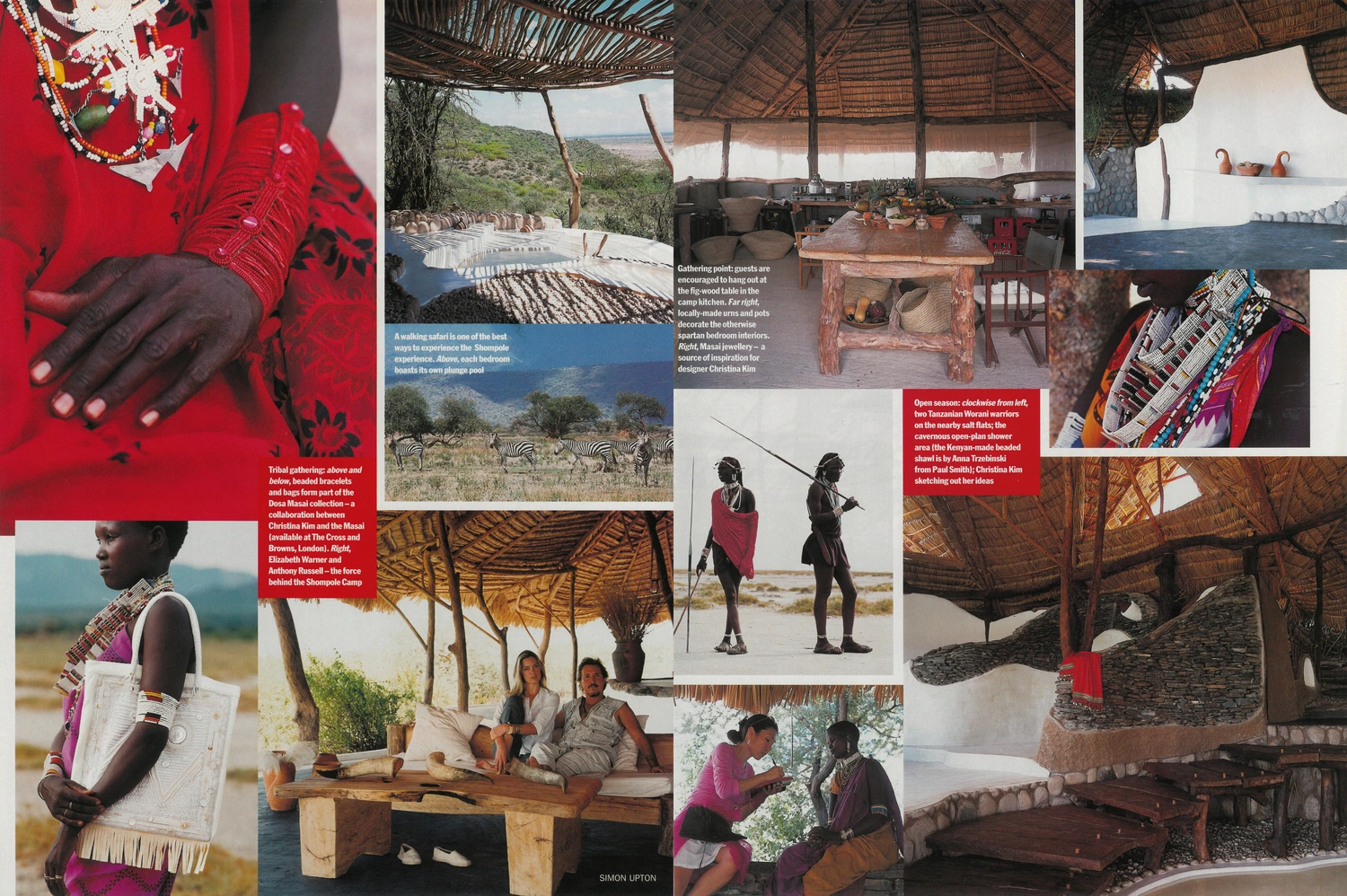
At the heart of all this is the camp itself, a lodge nestled on the side of the towering Nguruman escarpment overlooking Shompole Mountain – a location that was carefully chosen by Russell "for the views and the breezes". There are six staggeringly beautiful thatched bedrooms, a general mess room where drinks and meals are served, and a busy kitchen where guests are encouraged to hang out at a big fig-wood table and chat with Patrick, the camp's chef. This is undoubtedly the cosiest room here, with floppy baskets overflowing with tumbling fruit and vegetables in every corner, stacks of giant wooden bowls, and culinary supplies piled up around the walls.
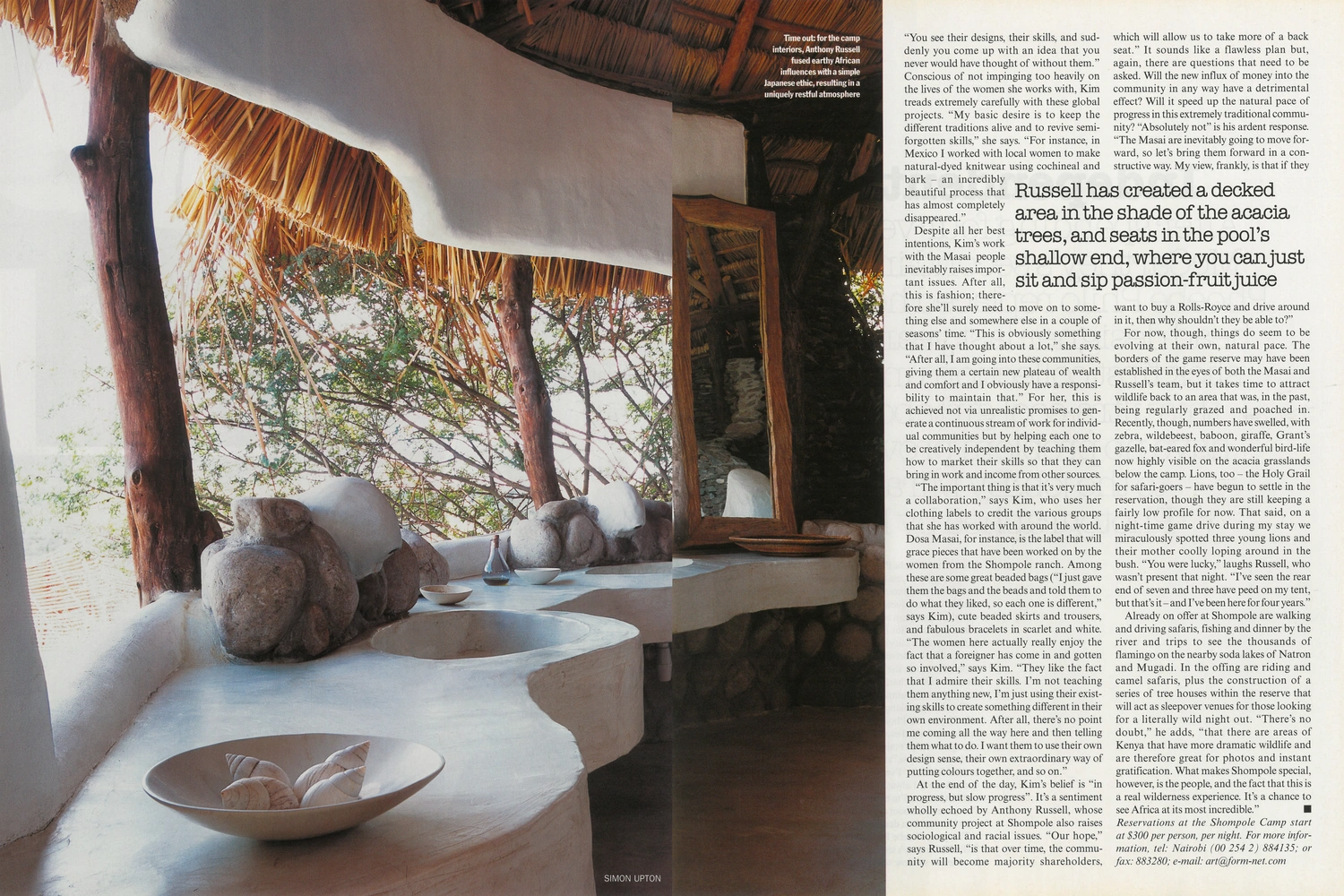
"A lot of thought went into the design," says Russell, "with a basic starting point of open-plan rooms and lots of water. The overall aesthetic is a Japanese and African mix." It's a great combination, with the earthier African elements – stone, thatch, wood – mixing beautifully with the simple white concrete, pale pebbles and water details that owe much to the Far East. "It's very hot and dry here for most of the year," he explains, "so I liked the idea of cool spring water running through every bedroom and a deep plunge pool for taking a quick, icy dip." There is also a swimming pool, which is filled with spring water, too. Russell feels that guests will come to Shompole as much for a rest as to see the wildlife and, with this in mind, he has created a large decked reading and sunbathing area in the semi-shade of the acacia trees and has even placed shaded seats in the pool's shallow end, where you can sit and sip a passion-fruit juice.
Shompole is at once perfectly understated and remarkable in its attention to detail. The sweeping thatched structures, with intricate contoured roofs designed to reflect the silhouette of the surrounding mountains, have towering ceilings that make for a wonderful feeling of space and light. The furniture is simple: fig-wood tables, benches and wide sofas made by local Masai craftsmen. There is very little decoration ("why hang a picture?" says Russell), but local bits and pieces – ostrich eggs, feathers and white land-snail shells laid carefully in soap-stone bowls, and terracotta urns filled with knobbly walking sticks – are scattered here and there.
The temptation, of course, is to keep on accessorising the interiors, but it's actually the spareness of the design that is Shompole's trump card. Each bedroom is the size of a sprawling Hoxton loft, with its series of water pools, open-plan shower (fear not, your privacy is perfectly protected) and seating area in dappled shade that houses one perfect, white-linen-clad wooden sofa. There are few solid walls and at night, tightly zipped into your mosquito tent and with only a thatched roof above your head, you get the feeling that there is very little between you and the wildlife. For those who find the sensation too unnerving (the sounds of baboons squawking, lions roaring and giant bugs thwacking into your mossie net take a bit of getting used to), there are curtains that can be drawn around the bed.
In line with Shompole's conservationist stance, the rooms are also environmentally friendly: pebbles are naturally occurring white-quartz stones gathered from local river beds, the vast wooden interior struts are from dead ficus sycamore trees from nearby woodland, and the bullrushes used for thatching are harvested from the swamp area that lies between the camp and Lake Magadi. Meanwhile, overflow from the swimming or plunge pools feeds directly into the newly dug watering hole just below the camp that's designed to attract wildlife. Power is principally solar-generated and, of course, the loos are fully self-composting, (aided by guests throwing in a few scoopfuls of woodchippings). And it doesn't stop there. The compost – though this bit doesn't bear much thinking about – will eventually be used to fertilise the vegetable garden, thereby allowing Shompole to grow a wide selection of goodies, currently imported from Nairobi.
The Shompole safari camp and game reserve sit right on the crest of a fashionable new wave of eco-tourism. However, along with a handful of other like-minded projects, Shompole is about more than just recycled building materials and composting loos. Those elements are a given, but it's Russell's partnership with the local Masai community in the building, running and management of the camp and game reserve that is unique. "Eco-tourism, to me, is very much about employment," says Russell. "We are in the business of protecting and developing an entire area, and the local people – not just the wildlife and the grasslands – are a key part of that."
Warner, Russell's American girlfriend, is also playing a crucial role in his community projects at Shompole. A former model and mosaicist, she has now turned her talents to a series of beading projects with the Masai women that she hopes will give them "a much-needed income of their own and, as a result, a newly elevated status." As Russell explains, "Community, Conservation, Commerce and Capacity-building are the four watchwords of the Shompole project, and the work that Warner has been doing with the women plays a really important part in all that."
Though she runs her own company, Masai Collections, at the moment, Elizabeth is almost wholly focused on helping Christina Kim, the designer of the LA-based fashion label Dosa, who, in the latest of many projects working with different cultures around the globe, is currently putting together several collections with the help of the Masai women at the nearby village of Oloordikalani (which, roughly translated, means "people of the red cloak"). "I have worked with many different cultures in different countries including Mexico, India, Japan, Cambodia and China," says Kim who, though she emanates a remarkable sense of Zen-like calm, also possesses an impish sense of humour. "My family have always been great travellers and I now spend around six months of the year in different countries getting inspiration for, or working on, elements of my collections." The Dosa label has earned a cult global following for its simple, pretty, wearable pieces that often reference different cultures – particularly those of the East – but never in too slavish a way. For instance, Kim cites a pair of Bedouin trousers given to her by an old boyfriend as the loose inspiration for a trouser shape that was a hit in her collections for many years. "I was first inspired by a jacket worn by my t'ai chi teacher," she laughs. "It had the most fantastic collar shape. I also loved the fact that it was without gender. That's how Dosa began and, funnily enough, the idea really took off."
Kim's work with far-flung and often impoverished communities stems from a genuine philanthropic streak, though she is the first to confess that she's not entirely without her own motives. "Being with these women is an incredibly creative experience for me," she says. "You see their designs, their skills, and suddenly you come up with an idea that you never would have thought of without them." Conscious of not impinging too heavily on the lives of the women she works with, Kim treads extremely carefully with these global projects. "My basic desire is to keep the different traditions alive and to revive semi-forgotten skills," she says. "For instance, in Mexico I worked with local women to make natural-dyed knitwear using cochineal and bark – an incredibly beautiful process that has almost completely disappeared."
Despite all her best intentions, Kim's work with the Masai people inevitably raises important issues. After all, this is fashion; therefore she'll surely need to move on to something else and somewhere else in a couple of seasons' time. "This is obviously something that I have thought about a lot," she says. "After all, I am going into these communities, giving them a certain new plateau of wealth and comfort and I obviously have a responsibility to maintain that." For her, this is achieved not via unrealistic promises to generate a continuous stream of work for individual communities but by helping each one to be creatively independent by teaching them how to market their skills so that they can bring in work and income from other sources.
"The important thing is that it's very much a collaboration," says Kim, who uses her clothing labels to credit the various groups that she has worked with around the world. Dosa Masai, for instance, is the label that will grace pieces that have been worked on by the women from the Shompole ranch. Among these are some great beaded bags ("I just gave them the bags and the beads and told them to do what they liked, so each one is different," says Kim), cute beaded skirts and trousers, and fabulous bracelets in scarlet and white. "The women here actually really enjoy the fact that a foreigner has come in and gotten so involved," says Kim. "They like the fact that I admire their skills. I'm not teaching them anything new, I'm just using their existing skills to create something different in their own environment. After all, there's no point me coming all the way here and then telling them what to do. I want them to use their own design sense, their own extraordinary way of putting colours together, and so on."
At the end of the day, Kim's belief is "in progress, but slow progress". It's a sentiment wholly echoed by Anthony Russell, whose community project at Shompole also raises sociological and racial issues. "Our hope," says Russell, "is that over time, the community will become majority shareholders,which will allow us to take more of a back seat." It sounds like a flawless plan but, again, there are questions that need to be asked. Will the new influx of money into the community in any way have a detrimental effect? Will it speed up the natural pace of progress in this extremely traditional community? "Absolutely not" is his ardent response. "The Masai are inevitably going to move forward, so let's bring them forward in a constructive way. My view, frankly, is that if they want to buy a Rolls-Royce and drive around in it, then why shouldn't they be able to?"
For now, though, things do seem to be evolving at their own, natural pace. The borders of the game reserve may have been established in the eyes of both the Masai and Russell's team, but it takes time to attract wildlife back to an area that was, in the past, being regularly grazed and poached in. Recently, though, numbers have swelled, with zebra, wildebeest, baboon, giraffe, Grant's gazelle, bat-eared fox and wonderful bird-life now highly visible on the acacia grasslands below the camp. Lions, too – the Holy Grail for safari-goers – have begun to settle in the reservation, though they are still keeping a fairly low profile for now. That said, on a night-time game drive during my stay we miraculously spotted three young lions and their mother coolly loping around in the bush. "You were lucky," laughs Russell, who wasn't present that night. "I've seen the rear end of seven and three have peed on my tent, but that's it – and I've been here for four years."
Already on offer at Shompole are walking and driving safaris, fishing and dinner by the river and trips to see the thousands of flamingo on the nearby soda lakes of Natron and Mugadi. In the offing are riding and camel safaris, plus the construction of a series of tree houses within the reserve that will act as sleepover venues for those looking for a literally wild night out. "There's no doubt," he adds, "that there are areas of Kenya that have more dramatic wildlife and are therefore great for photos and instant gratification. What makes Shompole special, however, is the people, and the fact that this is a real wilderness experience. It's a chance to see Africa at its most incredible."
text: Susie Forbes
photo: Simon Upton